
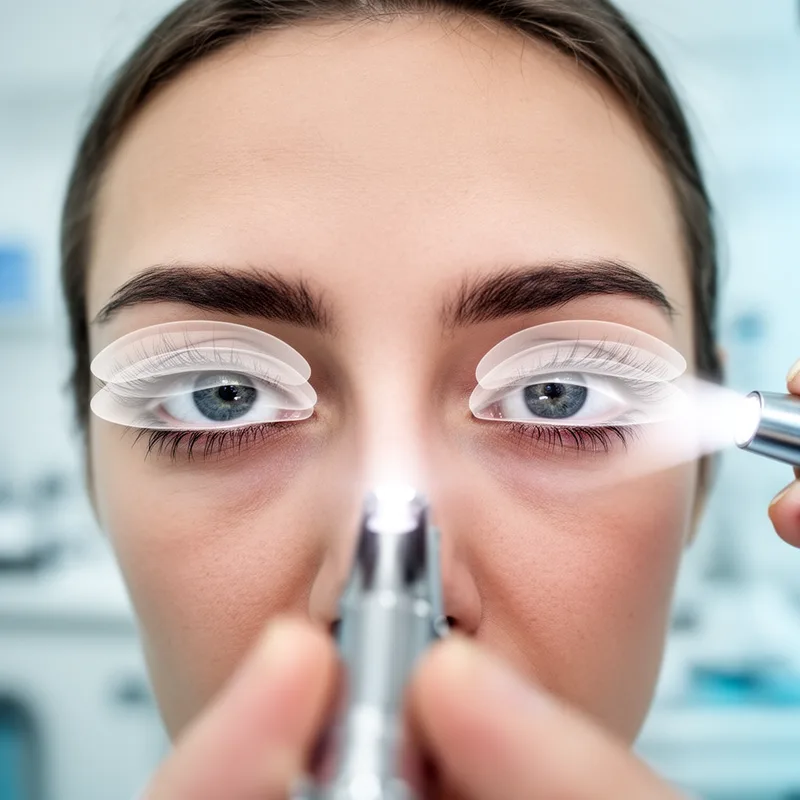
to palpebrate
- verb
- /ˈpæl.pə.breɪt/
- The patient began to palpebrate rapidly as the bright light shone in his eyes.
Examples
-
The cat palpebrates its eyes when it wakes up.
-
He palpebrates whenever he feels sleepy.
-
He would nervously palpebrate whenever asked a difficult question.
-
Some reptiles palpebrate to clear debris from their eyes.
-
The baby started to palpebrate as the flash from the camera startled her.
-
During the allergy test, she had to palpebrate to ease the irritation in her eyes.
-
He often palpebrates when he is tired and trying to stay awake.
Synonyms

 41
2.9
41
2.9

To close and open the eyelids to stop tears from falling
 23
7.4
23
7.4
To quickly close and open the eyelids as a sign
 10
3.7
10
3.7
To move the eyelids quickly and lightly, like a short blink
 9
6.2
9
6.2
To blink many times to stop tears or strong feelings

To move your eyelashes quickly in a playful way to get what you want
Antonyms

How Often

Surface Forms
Morphology
palpebrate = palpebra (opaque) = palpebr + ate
The base is a learned Latin medical form ('palpebr-/palpebra') that is unfamiliar to average learners, so the meaning 'blink / having eyelids' is not derivable from common English vocabulary.
Etymology
Palpebrate comes from the Latin palpebra 'eyelid' and the old verb palpare 'to touch gently'. So imagine your eyelids 'touching' your eye when you blink — that image helps: to palpebrate is to wink or blink, often repeatedly.