
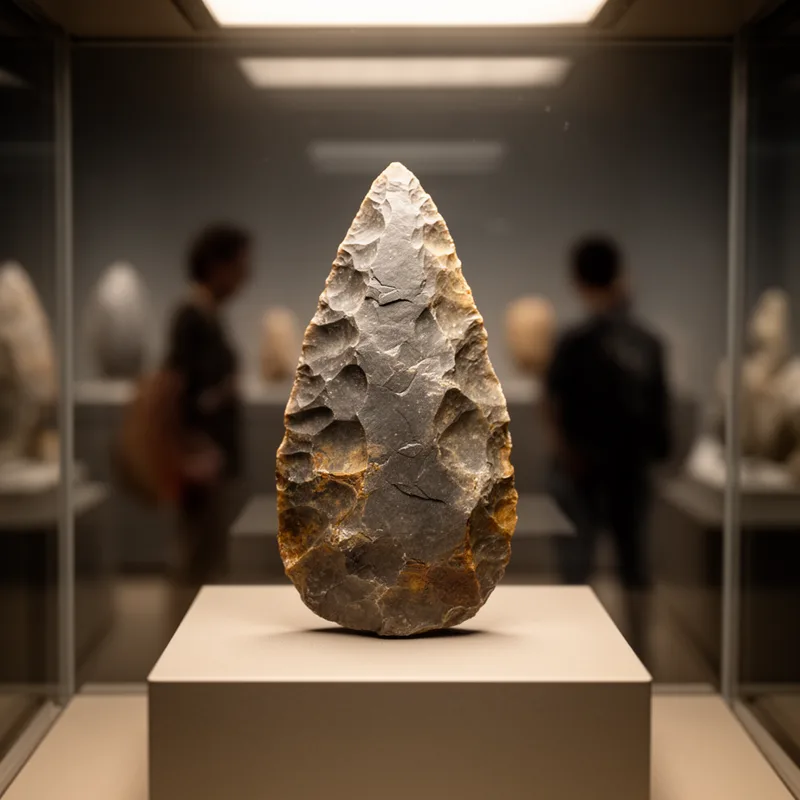
paleolith
- noun
- /ˈpeɪliəˌlɪθ/
- Specialized
- Many museums display paleoliths as key exhibits from the prehistoric era.
Examples
-
Many paleoliths were found at that excavation site.
-
The archaeologist discovered a paleolith in the cave.
-
A single paleolith can reveal much about the daily lives of early humans.
-
Archaeologists discovered a paleolith buried deep within the ancient cave.
-
Archaeologists discovered a paleolith that dates back to the early Stone Age, showcasing the ancient techniques used by our ancestors.
-
The museum has a fascinating exhibit featuring a paleolith used for cutting, highlighting the ingenuity of early humans.
-
During the excavation, a rare paleolith was unearthed, providing insight into the tools utilized by prehistoric hunter-gatherers.
Synonyms


 1
9.5
A stone early people used to hit and shape other stones into tools
Surface Forms
Morphology
paleolith = paleolithic (semi-transparent) = paleo + lith
Formally related to 'paleolithic' and the combining form '-lith' meaning 'stone', but the bound form 'lith' is not a familiar standalone word to many learners, so derivation is only partly clear.
Etymology
The word paleolith is made of parts that mean 'old' and 'stone': paleo- means 'old', as in paleolithic, and -lith means 'stone', so a paleolith is literally an 'old stone', a stone tool made and used long ago.