
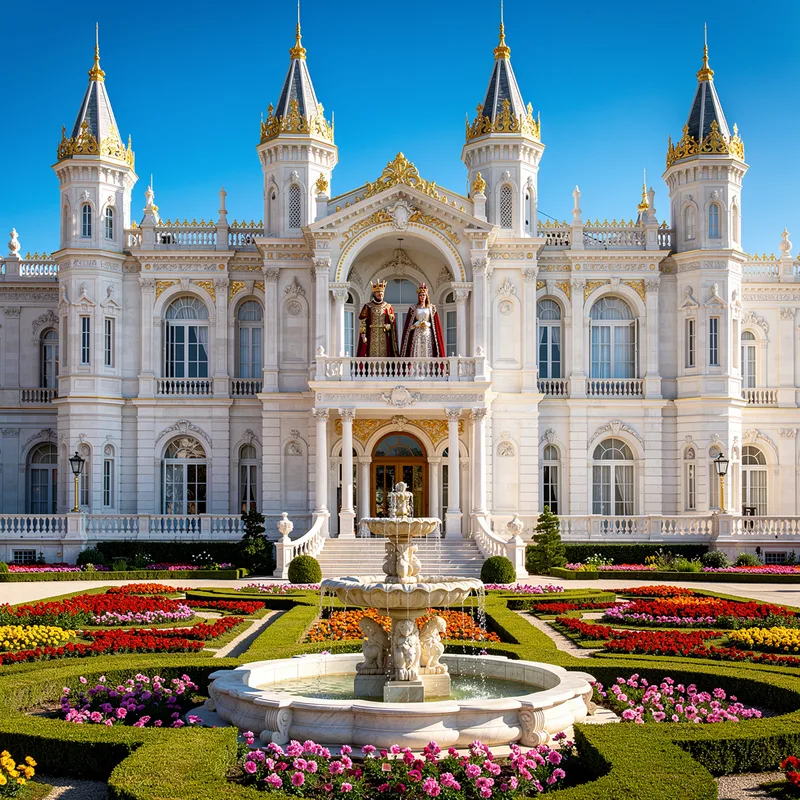
palace
 241
1.0
241
1.0

- noun
- /ˈpælɪs/
- He had a great big old palace up on the hill.
- royal palace
- entrance to the palace
- presidential palace
Loading YouTube…
Watch on YouTubeHold up, you're saying Buckingham Palace has HR?
- Hold up, you're saying Buckingham Palace has HR?
- You give half awake queen aunt that's in her palace giving orders.
- And I am thrilled to see how many castles and what palaces are in the city.
- She's not lodged in the new palace with him.
- He showed me that even in a palace, one could live simply and unpretentiously.
- And now that's the door of the palace of the Cardinal of Cusco, city of the church.
- So she is working her way into the palace to kill crier.
Examples
-
After the parade, the king returned to his magnificent palace to greet his guests.
-
But you will like the summer palace better.
-
We'll march into her palace and see for ourselves.
-
Welcome to my palace, darling.
-
It's just down the street from the palace on the main square.
Fiction book (1990) -
Great to be back here at the palace.
-
I would like to see the palace of the queen, said the rabbit.
Fiction book (1992) -
The king will leave Balmoral and return to Buckingham Palace tomorrow morning.
-
After the general's residence came to an end in 1816, the palace was stripped and its works sold.
Academic text (2012) -
The princess noted that even the water below the multi-tiered palace was sun-dappled and gleaming.
Fiction book (1992)
Synonyms
 676
1.7
676
1.7
A large strong building where a ruler or noble lives
 327
3.4
327
3.4
A very large, impressive house often with many rooms and gardens
 54
3.5
54
3.5
A large official house where an important person, like a president, lives
 2
5.7
2
5.7
A large, impressive house in the country owned by a rich family
 1
9.1
1
9.1
A large grand house used as a private home
Compounds

 4
3.9
4
3.9
A large luxury hotel and casino on the Las Vegas Strip known for Roman-style buildings and big shows


 1
6.1
1
6.1
A large royal building near Paris built for King Louis XIV with grand rooms and famous gardens



How Grand

Surface Forms
Etymology
Palace comes from the Latin Palatium, the name of the Palatine Hill in Rome where emperors lived, so it became a word for a 'royal house'.