
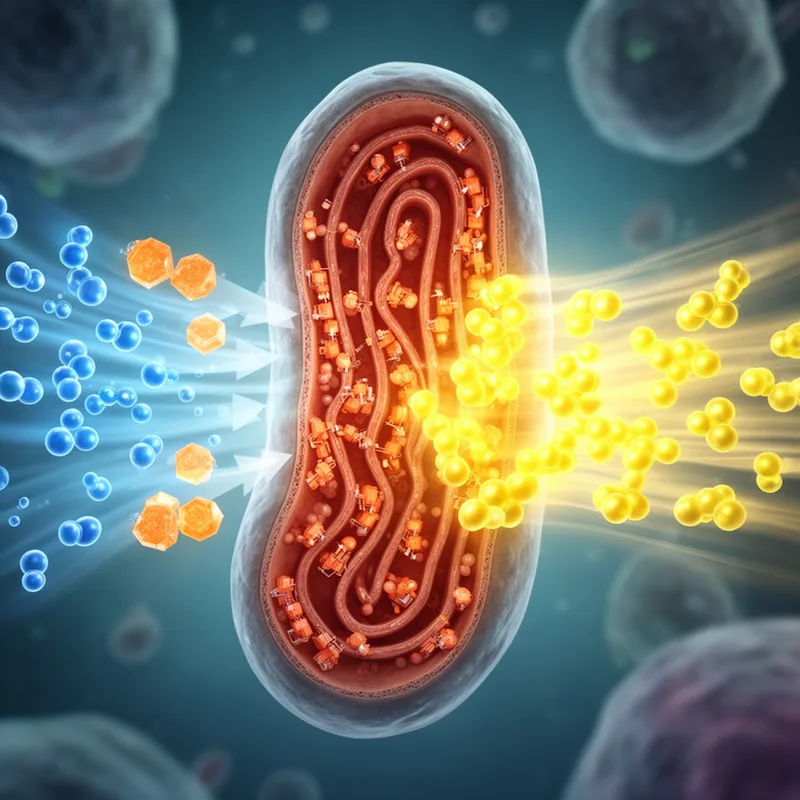
oxidative phosphorylation
- noun
- /ˌɑksɪˌdeɪtɪv ˌfɔsfoʊrɪˈleɪʃən/
- Specialized
- The two sets of genes both coded for proteins associated with a mitochondrial complex essential for oxidative phosphorylation, producing energy in the form of ATP for the cell.
- ATP in oxidative phosphorylation
- process of oxidative phosphorylation
Examples
-
If 5% of ATP demand is shifted from oxidative phosphorylation to glycolysis, glucose demand by that cell is doubled.
Blog text (3) -
The 50+ group appears to lie along the glyoxylate and dicarboxylate metabolism axis. Exchange/demand reaction and oxidative phosphorylation remain the high contributors to variance for all three age groups.
Academic text (2018) -
And so the light reactions are really along the same lines of the oxidative phosphorylation electron transport chain that we described.
-
And you'll see that it is similar to oxidative phosphorylation in many, many ways.
-
These two molecules are the electron donors that ultimately transfer electrons to the MRC to begin the process of oxidative phosphorylation (below).
Academic text (2017) -
Proteins associated with oxidative phosphorylation and mitochondria were significantly overrepresented within the list of differentially expressed proteins.
Academic text (2010) -
Mitochondrial cristae greatly increase the surface area of the inner membrane, thus providing large areas for membrane-dependent processes, such as oxidative phosphorylation. High degrees of membrane curvature are needed to accommodate this expansion of membrane.
Academic text (2017) -
Through a process known as oxidative phosphorylation, they produce most of the cell's chemical energy in the form of adenosine triphosphate or ATP.
-
This recycling of ATP is called oxidative phosphorylation, and the by-products of these pathways are CO2 and water.
Surface Forms
Morphology
The phrase is compositionally regular: 'oxidative' (involving oxidation) modifies 'phosphorylation' (addition of a phosphate group), so a learner who knows both constituents can infer it refers to a phosphorylation process linked to oxidation. However, the full technical meaning (the specific enzymatic sequence that synthesizes ATP) requires domain knowledge beyond basic constituent meanings, so it is not fully predictable for a B1 learner.
Etymology
The term oxidative phosphorylation comes from two parts: oxidative meaning 'using oxygen to release energy' and phosphorylation meaning 'adding a phosphate, a small energy piece, to a molecule'. So the name shows the process — using that released energy to attach a phosphate and make ATP, the cell's energy molecule.

