
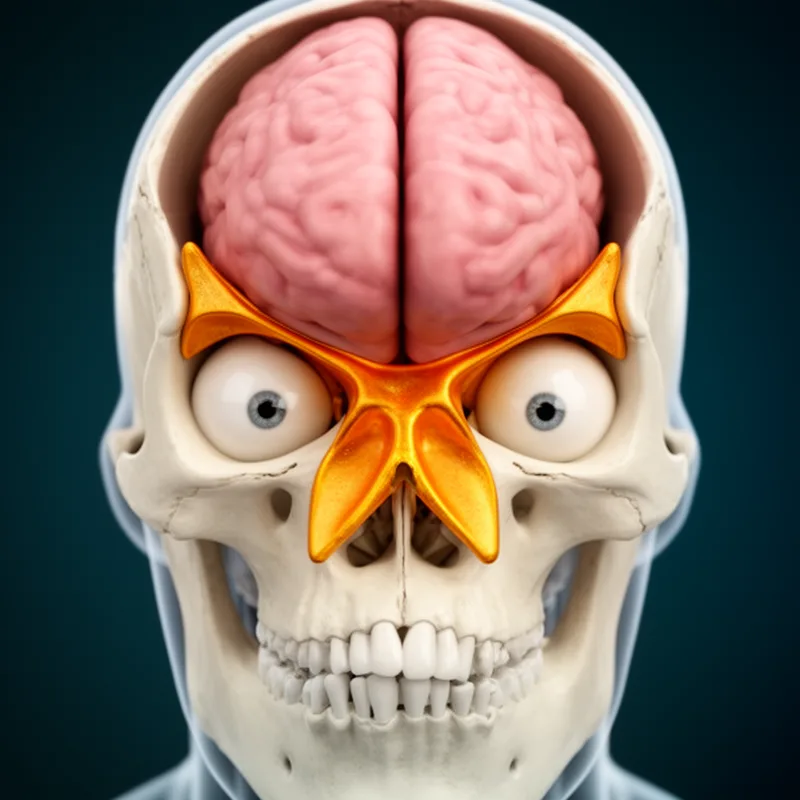
os sphenoidale
- noun
- /ˈɑs ˌsfɛnɔɪˈdeɪl/
- Specialized
- The os sphenoidale plays a crucial role in supporting the brain and forming the structure of the eye sockets.
Examples
-
Fractures of the os sphenoidale can have serious implications for cranial stability.
-
During surgery, the doctor carefully avoided damaging the os sphenoidale.
-
The os sphenoidale is crucial for skull integrity.
-
Anatomists study the os sphenoidale in detail.
-
The os sphenoidale connects to several other bones in the skull, making it vital for structural stability.
-
Damage to the os sphenoidale can affect vision and cranial health due to its location.
-
Understanding the anatomy of the os sphenoidale is essential for medical students studying the human skull.
Synonyms

 1
9.9
1
9.9

Butterfly-shaped bone at the skull base that forms part of the eye socket and holds the pituitary gland

A butterfly-shaped bone at the base of the skull that helps form the eye socket and supports the brain
Surface Forms
Morphology
os + sphenoidale
This is a technical Latin anatomical name: while 'os' (bone) is transparent, 'sphenoidale' is a specialized/unknown form and does not transparently convey ‘butterfly-shaped bone at the base of the skull.’ The overall meaning is technical and not derivable by an average B1 learner from the constituents alone, so it is unpredictable without prior exposure.
Etymology
Os sphenoidale is a Latin name: os means 'bone' and sphenoidale comes from a word for 'wedge' because the bone spreads like a small 'butterfly' at the base of the skull. So the name helps you remember it 'supports the brain' and 'forms the eye sockets'.