
orthotropic
- adjective
- /ɔrˈθrɒp.tɪk/
- Specialized
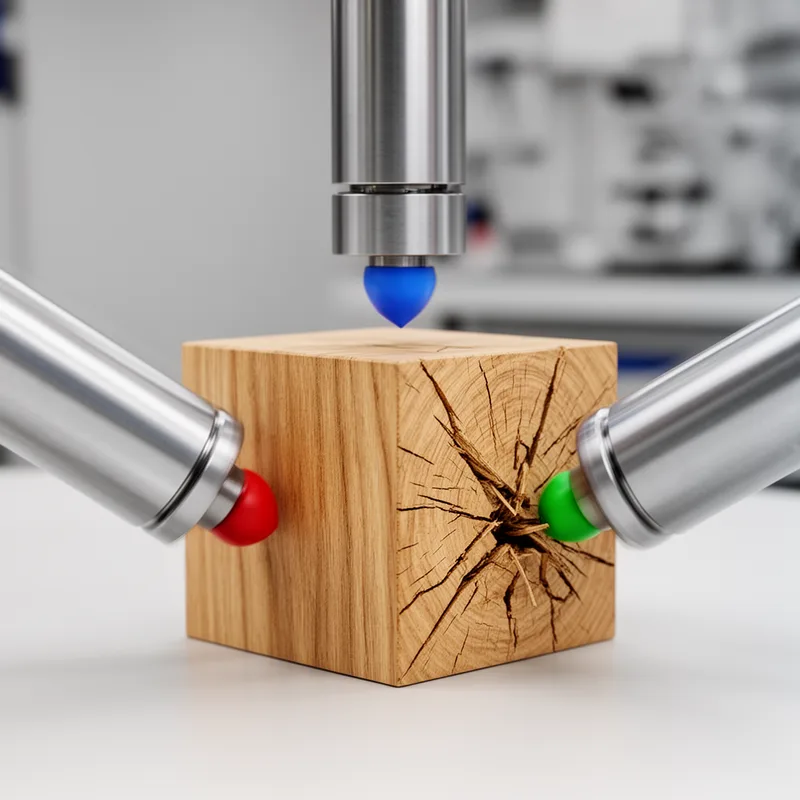
- Macroscopically, wood is an orthotropic material with three main directions, namely the longitudinal (L) direction, the radial (R), and the tangential (T) directions in the transverse plane.
- orthotropic material
Examples
-
Wood is considered an orthotropic material because its strength varies significantly in different directions.
-
The stability of the orthotropic cantilever plate with dimensions 1 x 1 in Fig. 8 is investigated. Two cases of the orthotropic material are studied.
Academic text (2018) -
So then the wood structure, we can think of it as orthotropic if we ignore the growth rings.
-
So I'm going to write down hooks law for our orthotropic material and then we'll talk about the constants that we're going to work out.
-
The stability of the orthotropic cantilever plate with dimensions 1 x 1 in Fig. 8 is investigated. Two cases of the orthotropic material are studied.
Academic text (2018) -
Unlike a metal whose strength properties are similar along each axis, wood has an orthotropic structure that exhibits varying strength properties along the tangential, radial, and longitudinal axes.
Academic text (1994) -
Due to its orthotropic nature, this composite material performs differently under stress along its three axes.
-
Engineers often prefer orthotropic materials for construction due to their unique strength and flexibility characteristics.
Synonyms



 1
9.9
1
9.9
A material that has different properties in different directions
How Directional

Surface Forms
Morphology
orthotropic = tropic (semi-transparent) = ortho + tropic
Built from 'ortho-' (right/orthogonal) + 'tropic' (orientation), which suggests differing directional properties, but the precise technical meaning (three mutually perpendicular axes) is specialized.
Etymology
Orthotropic comes from the Greek parts ortho- meaning 'straight' and -tropic meaning 'turn' or 'direction', like in phototropic. So an orthotropic material has different strength or other properties in different 'directions', for example wood is stronger along the grain than across it.