
orbitally


 1
7.2
- adverb
- /ˈɔːrbɪtəli/
- Specialized
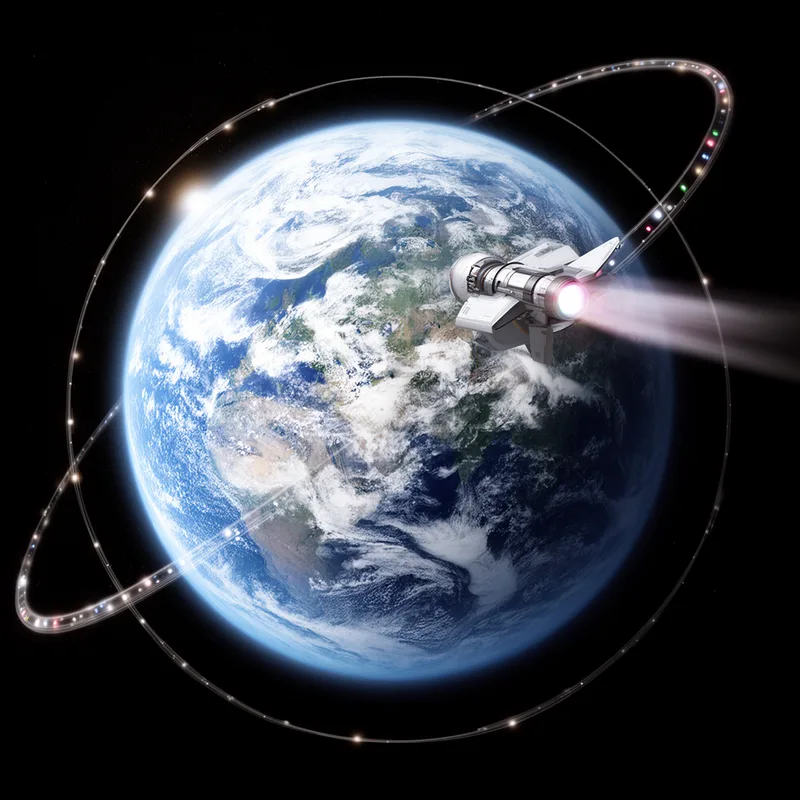
- The satellite was positioned orbitally to monitor the Earth below.
Examples
-
In astronomy, two bodies are said to be orbitally stable if their paths do not intersect.
-
How orbitally stable is it in that band of life possibility?
Blog text (17) -
The next best (actually, better) candidate is the Last Interglacial, about 125 kyr ago, again due to orbitally driven high insolation: the ice was likely very low, but we can't say whether it was completely ice-free in summer or not.
Blog text (9) -
On long-term time scales, changes in the hydrological cycle, and subsequently changes in the annual monsoon activity, are driven by orbitally forced insolation variability (Clemens et al. 1991).
Academic text (2018) -
Scientists studied the orbitally defined region around the planet to understand its gravitational effects.
Surface Forms
Morphology
Etymology
Orbitally comes from orbit, from Latin orbita, which meant 'path' or 'wheel track'. So orbitally means 'in a way that follows a path around' something, like a spacecraft around a planet.