

opera hood
- noun
- /ˈɑːpərə hʊd/
- Archaic
- She draped her opera hood over her shoulders before stepping out into the chilly night.
Examples
-
The audience in velvet opera hoods crowded the grand staircase of the old theater.
-
She wore a beautiful opera hood to the gala.
-
His grandmother's vintage opera hood was a family heirloom passed down for generations.
-
The opera hood was made of luxurious fabric.
-
She draped her opera hood over her shoulders before stepping into the theater for the evening performance.
-
His grandmother's vintage opera hood was worn by many guests at formal events in the past.
-
The elegant opera hood added a touch of sophistication to her evening attire.
Synonyms

 61
3.2
61
3.2

A loose outer coat that fastens at the neck and hangs down the back
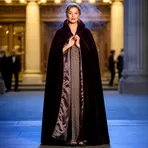 1
8.1
1
8.1
A large formal cape you wear over evening clothes to keep warm


 1
4.1
1
4.1
A long coat with a hood that you pull over your head
How Formal

Surface Forms
Morphology
The compound is compositional: 'opera' sets the social/contextual use (for the opera/formal occasions) and 'hood' names a garment covering the head, so a learner who knows both words can infer it is a hood or hooded garment worn to the opera. Although the full sense (a large, loose cloak-like hood) adds a specialized nuance, the core meaning is directly derivable from the constituents and follows a common noun–modifier pattern.
Etymology
Opera hood is named after the simple picture of a large, loose cloak with a hood that people put over their 'evening clothes' when they went 'to the opera' or other 'formal occasions'. That's why it means a big cloak worn over dress clothes for nights out.