
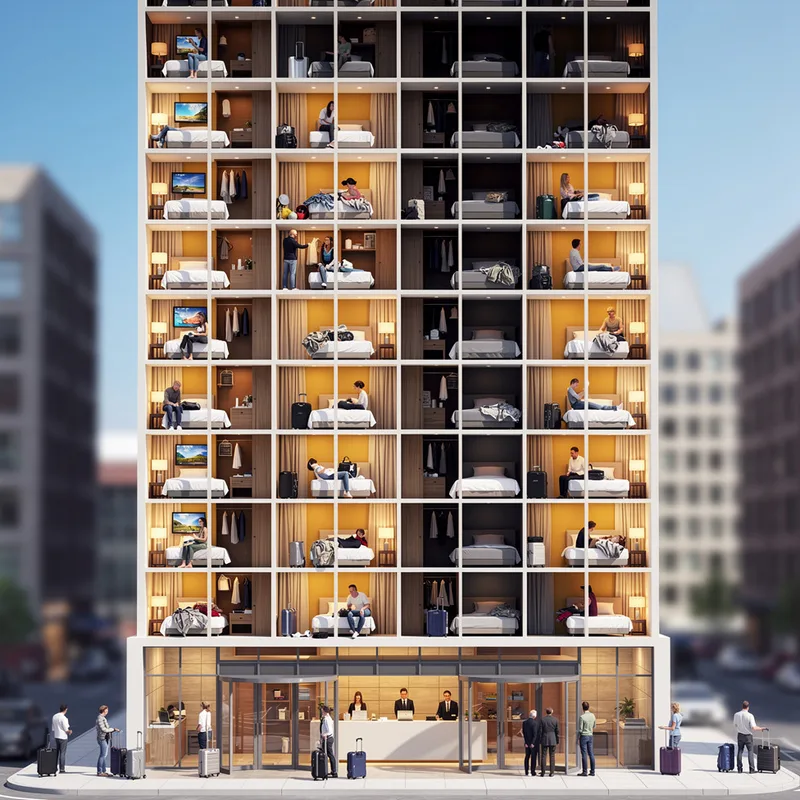
occupancy rate
 2
4.1
2
4.1

- noun
- /ˈɑkjəpənsi reɪt/
- Specialized
- During the peak tourist season, hotels typically experience occupancy rates exceeding 90%.
- bed occupancy rate
- low occupancy rates
- high occupancy rates
Examples
-
Higher occupancy rates paired with higher rental premiums equal more money in VCs' pockets.
Blog text (24) -
The majority (58 percent) had a teaching affiliation; 60 percent had an occupancy rate of over 68 percent.
Academic text (1995) -
The bed occupancy rate was 90%.
Academic text (1996) -
If our new marketing campaign couldn't raise our occupancy rate, Blue Moon would have to close.
Fiction book (2001) -
And the math works because hotel occupancy rates are at an all-time high.
Blog text (27) -
LFH has more than 500 beds and an occupancy rate of over 75%.
Academic text (1994) -
What business wouldn't want 20-year contracts with each state with a 90 percent occupancy rate?
Blog text (22) -
Other measures that have financial implications are patient-payer mix, Medicare/Medicaid mix, average length of stay, and occupancy rate.
Academic text (2001) -
Although traditionally viewed as a measure of utilization, hospitals are sensitive to the revenue implications of occupancy rates.
Academic text (1993) -
The one-person occupancy rate for renters climbed rapidly from 1940 (8 percent) to 1980 (36 percent).
Blog text (7)
Synonyms
 1
3.2
1
3.2
The percentage of a hotel's rooms that are occupied at a time

The part of hospital beds used by patients at a certain time
Antonyms
Surface Forms
Morphology
The meaning 'proportion of available resources in use' is directly and compositionally derived from 'occupancy' (the amount occupied or in use) plus 'rate' (a measured proportion), following standard noun–noun compounding patterns. Although it is often used in an IT/data-center domain, the semantic combination is straightforward and cross-linguistically common, so a B1 learner who knows both constituents will likely infer the meaning.
Etymology
Occupancy rate comes from hotels and buildings: imagine some rooms are occupied and others are empty, and the rate shows the 'percentage' of rooms taken, so it means how many of the available rooms are in use.