

oblique triangle


 1
6.9
1
6.9
- noun
- /əˈbliːk ˈtraɪæŋɡəl/
- Specialized
- When solving for the area of an oblique triangle, you can use the formula that involves the lengths of two sides and the sine of the included angle.
Examples
-
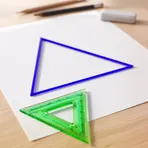
An oblique triangle can either be acute or obtuse, but it never has a right angle.
-
So if you have an oblique triangle now, and let's call this A, let's call this B, and let's call this C.
-
So if you have an oblique triangle now, and let's call this A, let's call this B, and let's call this C.
-
In geometry class, we learned that an oblique triangle differs from a right triangle by lacking a right angle.
Antonyms
Surface Forms
Morphology
The phrase is a straightforward adjective+noun composition — an 'oblique' (slanted/not perpendicular) triangle — so a learner who knows 'oblique' and 'triangle' can form a reasonable image. However, the exact geometric sense 'no right angle' is somewhat technical and requires knowing the specialized use of 'oblique' in geometry rather than only the general everyday sense, so it is not fully transparently predictable.
Etymology
Oblique triangle: The compound noun oblique triangle uses oblique meaning 'slanted' and triangle meaning a three-sided shape. Picture a triangle that leans so none of its corners has a perfect right angle, and that is why it means 'a triangle with no right angle'.