
nova
 7
8.6
7
8.6

- noun
- /ˈnoʊvə/
- Specialized
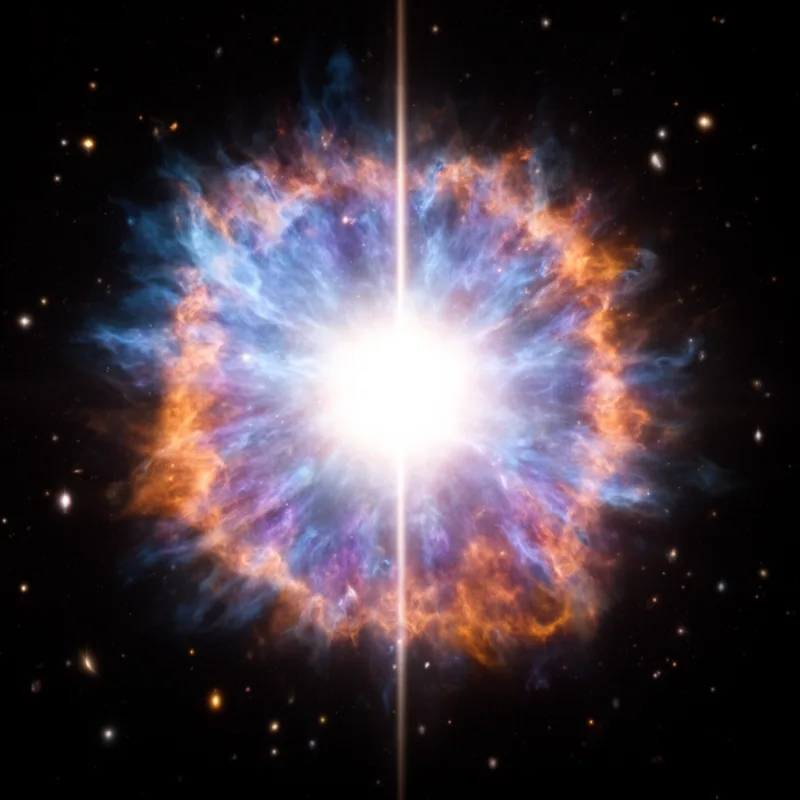
- A nova is a star that suddenly brightens and becomes visible in the night sky.
- nova explosion
Loading YouTube…
Watch on YouTubeThis is what is visibly a Nova seen in the night sky.
- This is what is visibly a Nova seen in the night sky.
- Now he said these brief brightenings all Nova, so not supernova like what happens when a star dies, but actually a sort of a brief brightening of a brand new star.
Examples
-
The ring is actually the edge of a bubble of hot gas blasted into space by the nova.
Academic text (1994) -
Immediately after the nova explosion, an envelope of gas ejected from the white dwarf surrounded the two stars.
Academic text (1994) -
A nova is when a star becomes unstable.
-
But you cannot conclude that 'the sun has gone nova' from this result.
Blog text (10) -
"Her heat signature went nova," Danny said.
Fiction book (1996) -
First, many cataclysmic variables undergo nova explosions, outbursts in their surface layers in which all of the accreted material is blown off.
Academic text (1991) -
Astronomers observed the remarkable explosion of a nova that lit up the dark cosmos.
-
When studying the nova, scientists noted the material expelled in a cloud around the star.
Compounds


- US
Thin slices of salmon people keep in salt and sugar that taste less salty and are often eaten on bagels


A salt-cured salmon that has less salt than usual and sometimes tastes a little sweet


A type of salmon lightly cured in salt water, usually less salty and sometimes made with sugar
How Bright
- Specialized
40
7.5

- Specialized
7
8.6
Surface Forms
Etymology
Nova comes from the Latin word novus, which means 'new', and it shares the same root as English words like novel and novice. A nova is called that because it looks like a 'new' star when it suddenly becomes very bright in the sky.