

nonpasserine
9.9
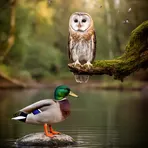
A bird that does not perch on branches, for example an owl or penguin
- adjective
- /nɒnˈpæsəraɪn/
- Specialized
:
no paseriforme
- Penguins are a well-known group of nonpasserine birds that are unable to fly but are excellent swimmers.
Examples
-
The albatross is a nonpasserine bird, known for its long wings and ability to glide over the ocean.
-
Most raptors, like eagles and hawks, are classified as nonpasserine birds due to their hunting adaptations.
-
These results are somewhat unusual because, in most vertebrate species, including many nonpasserine birds (see Schlinger and Arnold 1991), estrogens circulate at low levels in males.
Academic text (1994)
Antonyms

Compounds
Surface Forms
nonpasserine positive
Morphology
Etymology
Nonpasserine is made of non- meaning 'not' and passerine, from passer meaning 'sparrow'. So a nonpasserine is simply a bird that is 'not a sparrow-type' or not a typical perching bird, which is why owls, eagles, and penguins are often called nonpasserine.

