

nonflammable


 1
4.1
1
4.1
- adjective
- /nɒnˈflæməbl/
- Systems are designed to process safely and efficiently a wide range of both flammable and nonflammable solvents with boiling points up to 500 Fahrenheit; they are available with capacities of 55 gallons per 8-hour shift.
- nonflammable refrigerant
Examples
-
By blending refrigerants, it is possible to create new blends that are nonflammable but still contain moderately flammable refrigerants.
Academic text (1998) -
The new building materials are nonflammable, ensuring safety against fire.
-
Class 1 refrigerants are nonflammable; they show no flame propagation at ambient conditions at any concentration.
Academic text (1998) -
Class 1 zeotropic blends are formulated to be nonflammable even under the worst fractionation scenario.
Academic text (1998) -
Unlike the historical zeppelins, the new airship will be filled with nonflammable helium gas and have a rigid framework only at its keel.
Academic text (2000) -
NIST is now conducting tests to determine how much of one of these flammable mixtures can be added to a third nonflammable but lower-performing mixture before the resulting combination becomes flammable.
Academic text (1992) -
Meanwhile, Thomas Midgley, Jr., and Albert Henne published a paper in 1930 on fluorochemical refrigerants as a result of a search for stable, nontoxic, nonflammable, and efficient refrigerants.
Academic text (1998) -
Keep the cans of paint on a nonflammable surface to prevent any fire hazards.
-
Always store cleaning supplies in a nonflammable container to avoid accidents.
Synonyms
 5
4.9
5
4.9
Not easily set on fire and designed to slow the spread of flames
 5
4.0
5
4.0
Made so it does not burn in a fire
 5
4.4
5
4.4
Not easy to burn because it has a special treatment
 3
4.1
3
4.1
Not easily burned in a fire
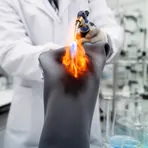 1
3.9
1
3.9
Hard to burn or set on fire
 1
5.3
1
5.3
Does not catch fire or burn
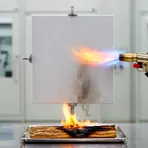
Not able to catch fire or burn
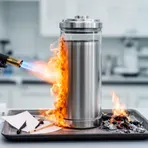
Not able to burn or be set on fire
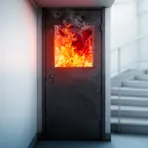
Does not burn easily in a fire, for example walls or doors
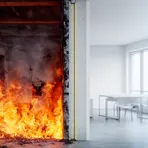
A material or building that is difficult to burn and able to stay whole in a fire for some time
Antonyms

How Flammable
41
2.8
 18
5.1
18
5.1
- Specialized
3
4.1
- Specialized
5
4.9
1
4.1
Surface Forms
Morphology
Etymology
Nonflammable comes from non- meaning 'not' and flammable, which comes from the simple word flame meaning 'fire'. So nonflammable means 'not able to catch fire' and is used for things that do not burn.