
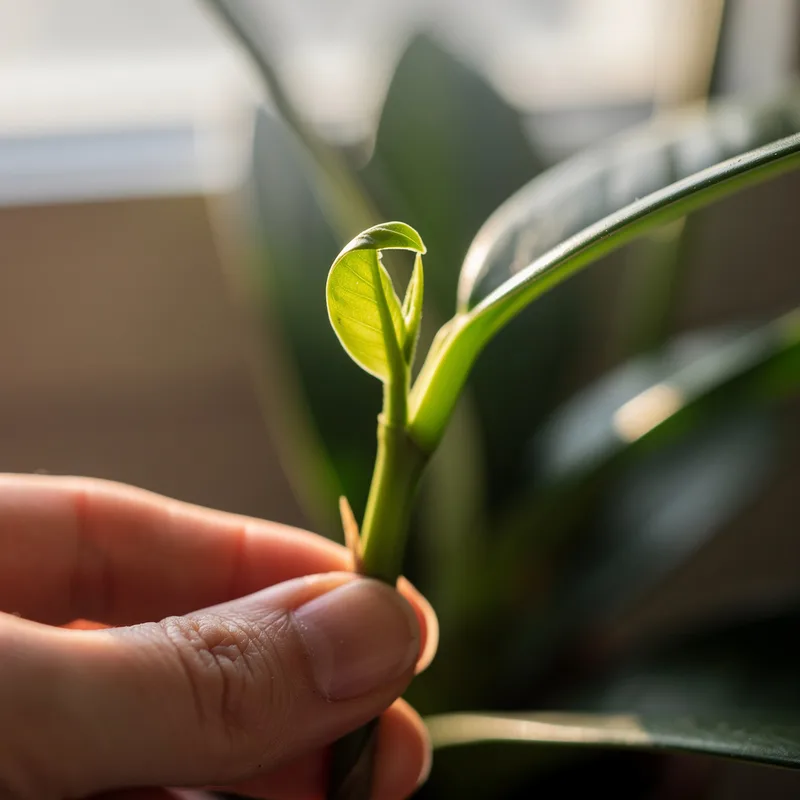
new leaf
 2
1.0
2
1.0

- noun
- /nuː liːf/
 :
hoja nueva
:
hoja nueva
- But if you look close at this thing, it's got buds just ready to burst and brand new leaves even down here.
- turn over a new leaf
So we do see some new leaves emerging, which is nice.
- So we do see some new leaves emerging, which is nice.
Examples
-
So we do see some new leaves emerging, which is nice.
-
We'll get all of those removed and just leave the good looking new leaves for this spring.
-
I'm going to modify the tree by adding a new leaf somewhere off of this path.
-
Basically, it'll put out a new leaf and then the old one will die and then it'll put out a new leaf and the old one will die and it just always looks a little unhappy.
-
The gardener was delighted to see several new leaves sprouting on the young plant.
-
As spring arrived, the tree began to grow new leaves that were vibrant and green.
-
After a few weeks of care, the plant produced its first new leaf, signaling healthy growth.
Antonyms



How Young
2
1.0
 370
1.0
370
1.0
Surface Forms
Morphology
The meaning 'a young leaf just beginning to grow' is directly and compositionally derived from 'new' (recent/young) + 'leaf' (plant organ). This simple adjective+noun combination follows standard English composition and is cross-linguistically common, so a B1 learner who knows both constituents will understand it.
Etymology
The noun new leaf names the fresh, young leaf on a plant or tree. It is the small green leaf that has just started to grow, so it literally means a 'young leaf'.