
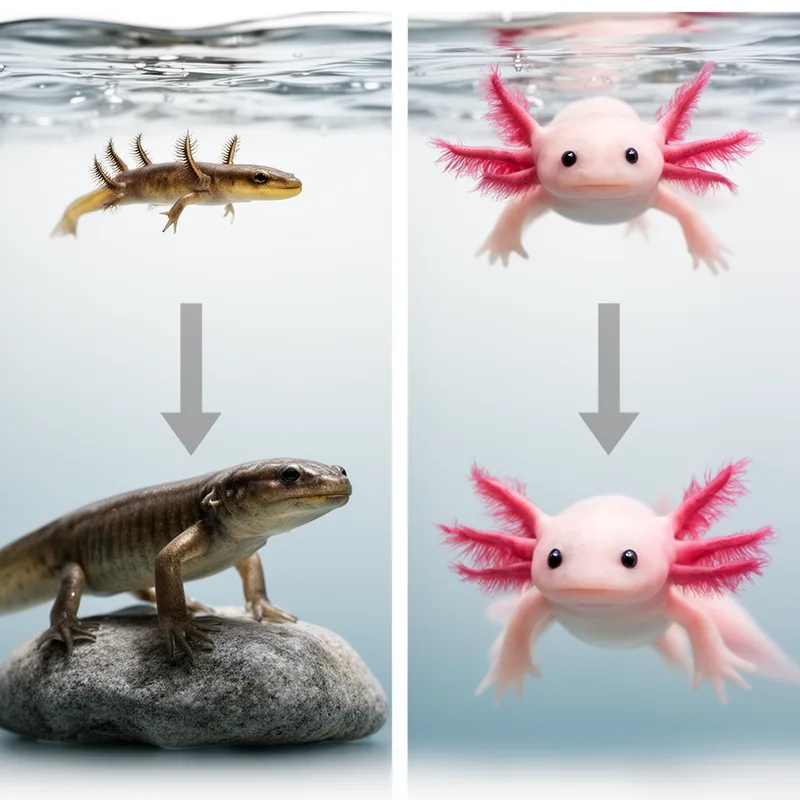
neotony


 1
9.9
- noun
- /niˈɑːtəni/
- Specialized
- The study explained how environmental factors could promote neotony in certain amphibians.
Examples
-
Human beings show some degree of neotony compared to other primates, such as flatter faces and larger brains.
-
The neotony of certain salamanders allows them to retain gills throughout their lives.
-
Axolotls are well-known for exhibiting neotony, retaining their gills even as adults.
-
Many species exhibit neotony as a survival strategy.
-
In some species, like certain breeds of dogs, neotony allows them to maintain playful characteristics throughout their lives.
-
The phenomenon of neotony can be observed in humans, where adults retain youthful features such as a round face.
-
Researchers study neotony to understand how juvenile traits can influence social behavior in adult animals.
Synonyms
 1
9.9
The keeping of young animals' body parts or looks in adults
 1
9.9
A process in which an animal keeps baby features as an adult
How Juvenile

Surface Forms
Morphology
neotony = neoteny (opaque) = neo + teny
Neotony is essentially an alternative/variant form of 'neoteny', so the relation to that base word is clear.
Etymology
Neotony comes from the Greek prefix neo- meaning 'young', as in neonate which means 'newborn'. So neotony is the 'state of keeping young' traits, and that is why biologists use it for animals that keep juvenile features into adulthood.