
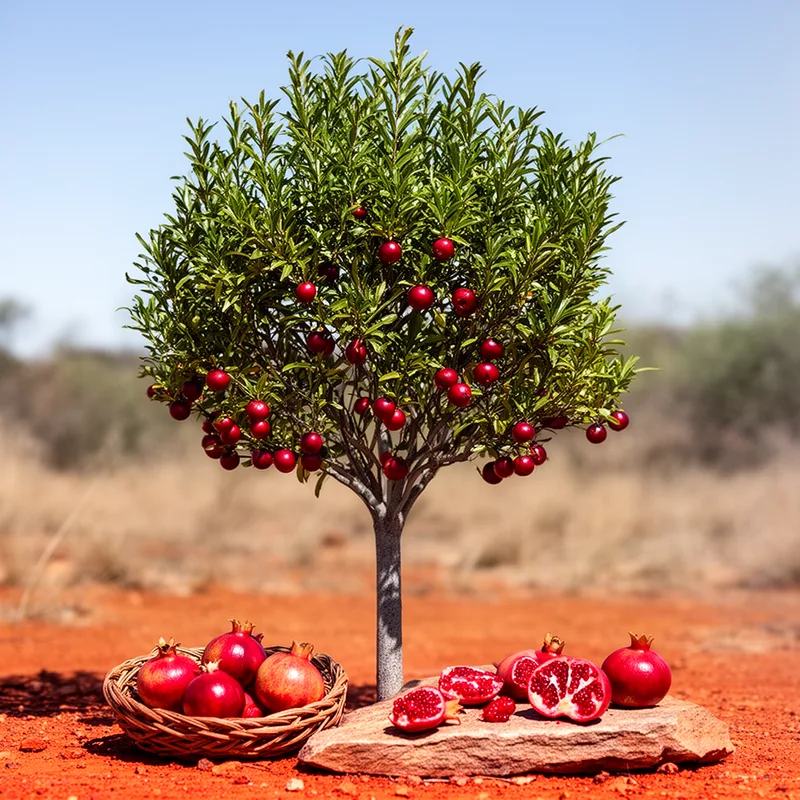
native pomegranate
- noun
- Australian
- The native pomegranate thrives in arid regions of Australia and bears fruit in summer.
Examples
-
The tart flavor of the native pomegranate makes it popular in jams and desserts.
-
Aboriginal Australians have long used the native pomegranate as a source of food and medicine.
-
The native pomegranate grows well in arid regions.
-
I saw a native pomegranate in the botanical garden.
-
Aboriginal Australians have long used the native pomegranate as a source of food and medicine.
-
The native pomegranate thrives in arid regions of Australia and bears fruit in summer.
-
The tart flavor of the native pomegranate makes it popular in jams and desserts.
Synonyms

A small Australian tree that has edible fruit like a pomegranate
A small Australian tree that grows dark purple fruit people eat, called wild orange
Surface Forms
Morphology
The phrase combines 'native' (indigenous) with 'pomegranate' (the fruit/tree), so a learner who knows both words can infer it denotes a pomegranate or pomegranate-like plant native to the area. Even if botanical specifics (it may not be a true pomegranate) are not transparent, the general referent and meaning are compositionally clear to a B1 learner.
Etymology
Native pomegranate gets its name from a small Australian tree that makes red, round fruit like a real pomegranate. Aboriginal people used the 'fruit' for 'food' and 'medicine', so today native pomegranate means this local tree and its edible fruit.

