

Capparis mitchellii
- noun
- Australian
- The fruit of the Capparis mitchellii is a traditional food among some Australian Indigenous communities.
Examples
-
The jam made from Capparis mitchellii fruit is highly prized in parts of Australia.
-
The Capparis mitchellii tree grows well in arid regions.
-
Botanists studied the unique adaptations of the Capparis mitchellii to arid climates.
-
Have you ever tasted the fruit of the Capparis mitchellii?
-
The fruit of the Capparis mitchellii is often used in desserts and is rich in flavor.
-
Many people enjoy making smoothies with the sweet fruit of the Capparis mitchellii.
-
In spring, the Capparis mitchellii produces beautiful flowers before bearing its dark purple fruit.
Synonyms

A small Australian tree that has dark purple berries you can eat
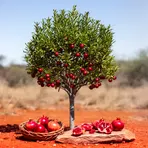
A small Australian tree that makes tart red fruit you can eat
Surface Forms
Morphology
Capparis + mitchellii
This is a Linnaean binomial: knowing 'Capparis' (a genus of shrubs/small trees) allows a learner to infer it names a species of that genus (i.e., a type of small tree), but 'mitchellii' is a Latinized species epithet (likely from a proper name) with no transparent lexical meaning for a B1 learner. Because the exact properties (edible dark purple fruit; 'wild orange') are not derivable from the constituents, the expression is only partially transparent.
Etymology
Capparis mitchellii may come from the caper plant group (Capparis) and from the explorer Thomas Mitchell (mitchellii). Its dark purple fruit looks like a small orange, so people call it the 'wild orange', which helps you remember it is a small Australian tree with edible fruit.

