

narrow-leaved reedmace
- noun
- /ˈnɛroʊˌlivd ˈriːdˌmeɪs/
- UK
- The narrow-leaved reedmace is easily recognized by its slender leaves and brown flower spike.
Examples
-
The wetland reserve is home to vast stands of narrow-leaved reedmace swaying in the breeze.
-
Conservationists study the spread of narrow-leaved reedmace along the lakeshore each summer.
-
The narrow-leaved reedmace grows abundantly in wetlands.
-
Many birds nest in the narrow-leaved reedmace.
-
The narrow-leaved reedmace thrives in wetland areas, creating a lush habitat for wildlife.
-
During my walk, I noticed the narrow-leaved reedmace along the banks of the pond, standing tall and graceful.
-
The distinct cylindrical flower spikes of the narrow-leaved reedmace are a common sight in marshy regions.
Synonyms

 5
4.2
5
4.2

A tall marsh plant with long flat leaves and a brown sausage-shaped flower spike

A wetland plant with narrow leaves and a brown flower spike

A tall marsh plant with long narrow leaves and a brown flower head

A tall water plant with long narrow leaves and brown flower spikes that grows in shallow water

A tall marsh plant with long flat leaves and long brown seed heads used for weaving mats and chair seats
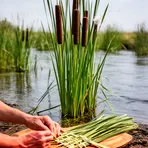
A tall marsh plant with long brown seed heads and flat leaves used for weaving
Surface Forms
Morphology
narrow-leaved + reedmace
The compound 'narrow-leaved' transparently means 'having narrow leaves' (narrow + leaved) and 'reedmace' denotes a specific wetland plant, so the combined phrase simply describes a reedmace with narrow leaves. This compositional adjective + noun structure follows common cross-linguistic patterns and would be immediately interpretable by a B1 learner who knows the constituents.
Etymology
Narrow-leaved reedmace gets its name from the plant's look: narrow-leaved means it has thin leaves, and reedmace comes from the long brown flower spike that people thought looked like a 'mace' or club. So the name describes this tall water plant with narrow leaves and a brown spike.