
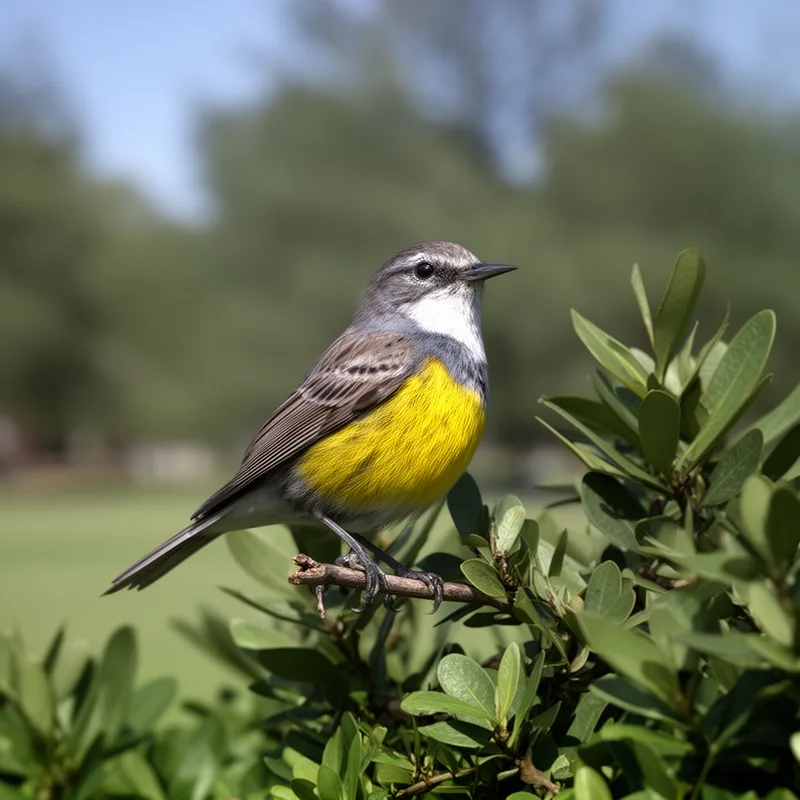
myrtle bird
- noun
- /ˈmɜːrtəl bɜrd/
- US
- The myrtle bird can often be seen flitting among the wax myrtle bushes.
Examples
-
The myrtle bird is known for its distinctive yellow markings.
-
Last spring, we spotted a myrtle bird during our birdwatching trip in the park.
-
Unlike Audubon's warbler, the myrtle bird has a distinct white throat.
-
Have you ever seen a myrtle bird in the wild?
-
We spotted a myrtle bird during our birdwatching trip at the nature reserve.
-
The myrtle bird can often be heard singing its cheerful song in the trees.
-
While hiking, we were delighted to see a myrtle bird flitting near the stream.
Synonyms
A small North American songbird with a yellow patch on its lower back

A small North American songbird with a white throat and bright yellow patches on its lower back and sides
Surface Forms
Morphology
myrtle + bird
Knowing 'myrtle' (a plant) and 'bird' would allow a B1 learner to infer that this refers to a bird associated with or named after the myrtle plant, so the general idea is derivable from the constituents. However, the precise referent — a specific North American warbler (yellow-rumped/Audubon's warbler) — is a lexicalized species name that cannot be fully predicted from the parts without prior exposure, making the expression only partially transparent.
Etymology
Myrtle bird comes from the bird's habit of feeding and hiding in myrtle bushes. People saw this bird in the myrtle, so the name stuck for this kind of warbler, now often called the 'yellow-rumped warbler'.

