

Dendroica coronata
- noun
- /ˌdɛn.drəˈɪ.kə kɔˈrɒ.nə.tə/
- Archaic
- The distinctive yellow patch makes Dendroica coronata easy to identify among other warblers.
Examples
-
Recent studies confirmed that Dendroica coronata can thrive in both coniferous and deciduous forests.
-
Every spring, birdwatchers eagerly search for the Dendroica coronata as it migrates north.
-
The Dendroica coronata is often found in coniferous forests.
-
Have you ever spotted a Dendroica coronata in the wild?
-
Birdwatchers often delight in observing the Dendroica coronata as it flits through the trees during migration.
-
With its striking yellow rump, the Dendroica coronata stands out among other songbirds in the forest.
-
The Dendroica coronata, known for its beautiful song, is a favorite among ornithologists.
Synonyms
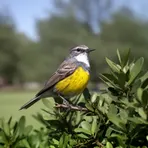
A small North American bird with yellow on its lower back
Surface Forms
Morphology
Dendroica + coronata
This is a Latin taxonomic binomial (a proper name) rather than a compositional English phrase: knowing the genus element 'Dendroica' (a group of songbirds) does not let a B1 learner infer the specific species meaning, and 'coronata' is not an English word in the input. The species sense ('yellow-rumped warbler') is language-specific nomenclature and not derivable from the constituents, so it would be opaque to learners.
Etymology
Dendroica coronata may come from old words dendro meaning 'tree' and coronata meaning 'crowned'. The name fits the yellow-rumped warbler because it lives in trees and has a bright patch that can look like a tiny crown.

