
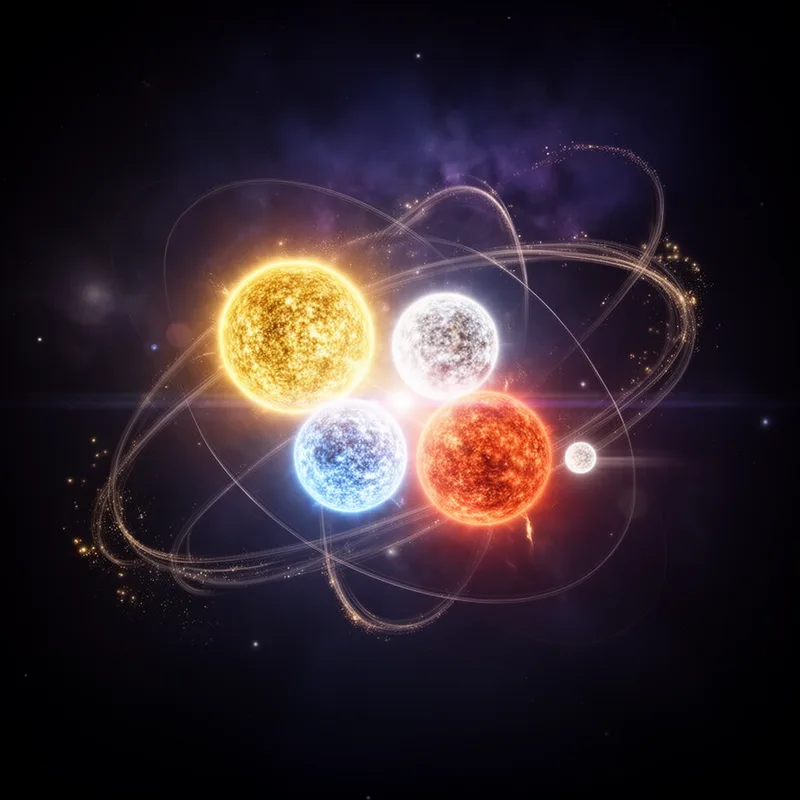
multiple star


 1
6.9
1
6.9
- noun
- /ˈmʌltəpəl stɑr/
- Specialized
- In fact, most of the stars in the sky are members of double or multiple star systems.
- multiple star system
Loading YouTube…
Watch on YouTubeAnd so there's it's a multiple star system and the nearest star in that star system is called Proxima Century.
- And so there's it's a multiple star system and the nearest star in that star system is called Proxima Century.
Examples
-
Astronomers estimate, however, that over half of all the Galaxy's stars are in binary or even other multiple-star systems.
Academic text (2004) -
It gradually became clear that multiple star systems are quite common.
Academic text (1992) -
If you have been studying astronomy for more than just a few days, you probably already know that binary and multiple stars are pretty common.
Academic text (1999) -
Mostly, though, these systems of multiple stars are just a ton of fun to goof around with and watch orbit around a browser window.
Blog text (26) -
And so there's it's a multiple star system and the nearest star in that star system is called Proxima Century.
-
The fact is that most stars are contained within binary or multiple star systems: at least 50% in binary-star systems, 13% in triple-star systems, and 4% in higher multiplicities.
Academic text (1999) -
On the first count, my study has expanded upon the study of individual stars to examine the reception of multiple stars, accounts of aspiring stars, and the conception of stardom in a specific discursive context.
Academic text (2017) -
Many astronomers study how stars within a multiple star system interact with each other due to their gravitational pull.
-
The telescope revealed a stunning view of the multiple star system, where three stars danced in a tight orbit around a common center.
-
In the night sky, the multiple star system appears as a single point of light, but it consists of several stars gravitationally bound together.
How Many
- Specialized
1
6.9

- Specialized
3
4.7
Surface Forms
Morphology
The phrase is directly compositional: 'multiple' means 'more than one' and 'star' is a celestial object, so a B1 learner who knows both words will infer it denotes more than one star (i.e. a system of stars). Although the full astronomical nuance of a gravitationally bound system is technical, the basic meaning is transparently derived from the constituents and is cross-linguistically regular.
Etymology
Multiple star comes from a simple image: multiple means 'more than one' and star is a star, so imagine several stars moving together around one center. That's why it means 'a group of three or more stars that move around the same point'.