
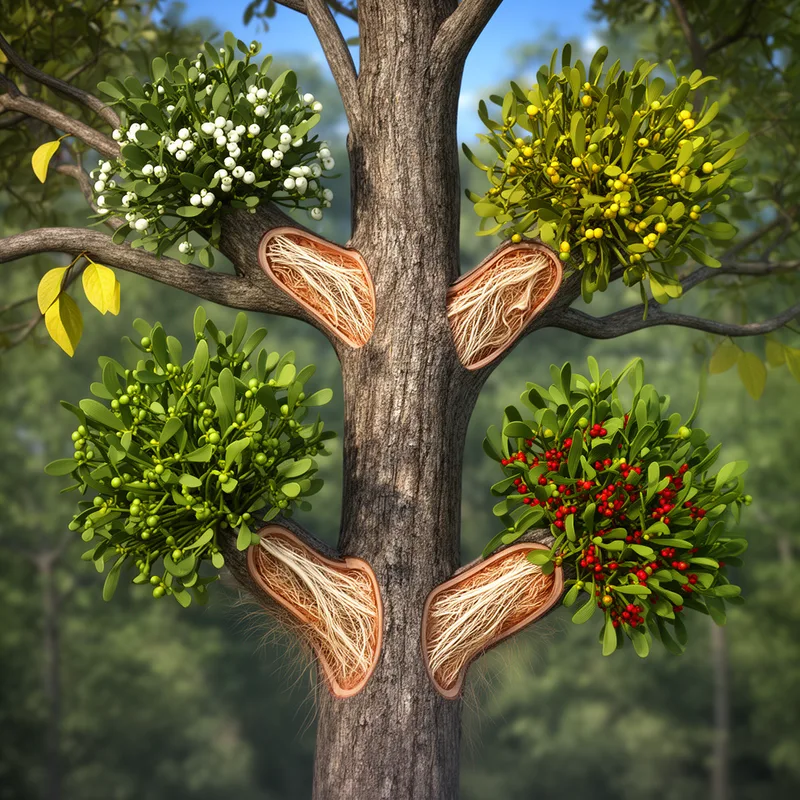
mistletoe family
- noun
- /ˈmɪsəlˌtoʊ ˈfæmɪli/
- Specialized
- The mistletoe family contains several species of parasitic plants found worldwide.
Examples
-
Species in the mistletoe family are often seen growing on the branches of trees.
-
The mistletoe family includes various species that thrive on host trees.
-
Some botanists classify the mistletoe family as a subfamily of Loranthaceae.
-
Did you know the mistletoe family can be found in many regions?
-
The mistletoe family includes a variety of species that attach themselves to different trees for nutrients.
-
Plants in the mistletoe family are known for their unique ability to photosynthesize while deriving nutrients from host plants.
-
Researchers study the mistletoe family to understand their role in ecosystems as both parasites and contributors to biodiversity.
Synonyms
A family of plants often shrubs or small trees that live on other trees and take water from them
A family of flowering plants that grow on other plants, like mistletoe
Surface Forms
Morphology
The phrase is a straightforward composition of 'mistletoe' (a plant) and 'family' (a grouping), so a learner who knows both words can infer it denotes the taxonomic or related group of plants that includes mistletoes. This is literal, non-idiomatic, and follows ordinary noun-noun composition found across languages, making the meaning transparent to B1 learners.
Etymology
Mistletoe family names a group of plants related to mistletoe that often grow on the branches of other trees. These plants attach to the tree and take some food and water from it, so the name links the picture of mistletoe to a family, meaning a group of similar 'parasitic' plants.

