
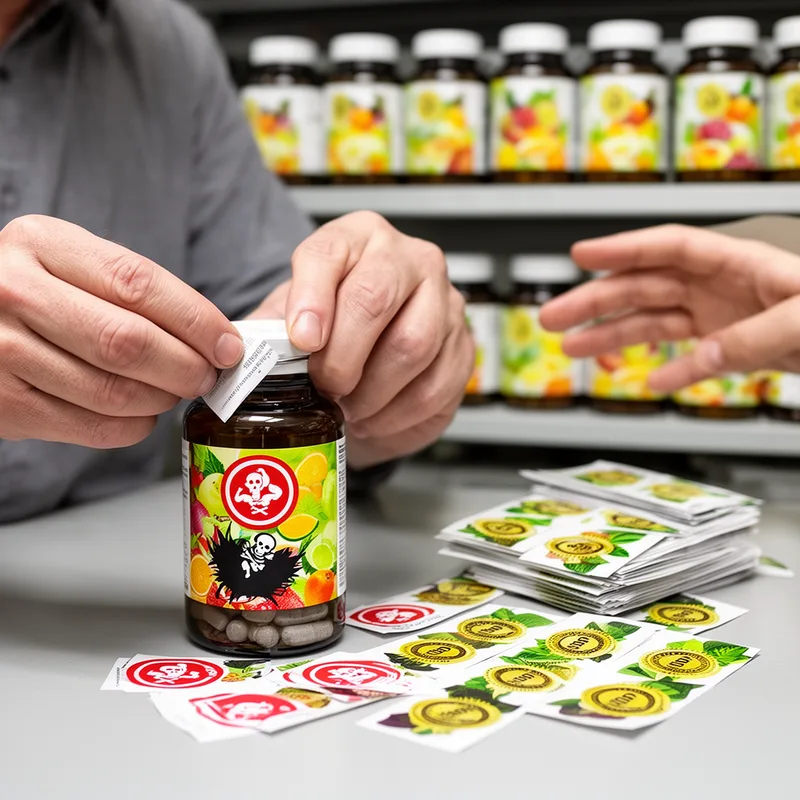
misbranding


 1
7.0
- noun
- /ˌmɪsˈbrændɪŋ/
- Formal
- The company faced legal consequences for the misbranding of its product that misled consumers about its health benefits.
Examples
-
The largest U.S. criminal fine ever was a $1.3 billion payment by drugmaker Pfizer in 2009, part of a $2.3 billion settlement in a case involving the misbranding of Bextra, an anti-inflammatory arthritis drug.
Blog text (34) -
It ruled that "the First Amendment... holds protected, and outside the reach of the FDCA's misbranding provisions, off-label promotion... where it wholly consists of truthful and non-misleading speech." 84
Academic text (2016) -
But a rational decision on whether to proceed criminally against those responsible for the misbranding may have to await consideration of a fuller record than that before the agency at the time of the civil seizure of the offending products.
Academic text (1990) -
GIB LLC, the North Hollywood, Calif., company that manufactures Brazilian Blowout, was cited last year by the FDA for "adulteration" and "misbranding" of its Acai solution.
Blog text (30) -
Companies can face steep fines for misbranding their products by making false claims about their effectiveness.
-
The recall was initiated due to misbranding, as the packaging did not accurately reflect the ingredients of the snack.
Synonyms
 7
7.7
To make a document or record false on purpose by changing its information
How Misleading

Surface Forms
Morphology
misbranding = misbrand (transparent) = mis + brand + ing
Formed by the verb 'misbrand' plus the nominalizing/gerund suffix '-ing'; the sense 'the act of labeling misleadingly' follows directly from its parts.
Etymology
The word misbranding comes from mis- meaning 'wrong' and brand meaning 'a mark or name for a product', like a brand name you know. So misbranding is putting the wrong mark or label on a product, for example giving it a false name or false claims.