

milk snake
- noun
- /mɪlk sneɪk/
- US
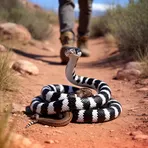
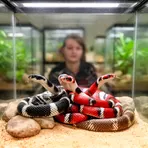
- A milk snake can be identified by its striking pattern of red, black, and white or yellow bands.
- Mexican milk snake
Loading YouTube…
Watch on YouTubeYou know, he's out here making milk snake skin sandals for deaf children or whatever.
- You know, he's out here making milk snake skin sandals for deaf children or whatever.
Examples
-
You know, he's out here making milk snake skin sandals for deaf children or whatever.
-
" That's no milk snake.
Fiction book (1996) -
Um, well, this is actually a milk snake.
-
It was just a little milk snake.
-
It was a snake—a harmless milk snake—but large and impressive as it coiled itself hastily into a semblance of death.
Fiction book (2000) -
The milk snake is often mistaken for the venomous coral snake due to its similar coloring.
-
Many people are surprised to learn that the milk snake is nonvenomous despite its resemblance to other harmful species.
Synonyms


 1
5.8
1
5.8
A North American snake that does not have venom and often eats other snakes and small animals

A snake from North and Central America that is not venomous and has bright bands like coral snakes

A harmless tan and brown snake often with red stripes and an arrow spot on its head
A group of snakes from the Americas that are not poisonous, like king and milk snakes
Surface Forms
Morphology
The compound follows a common noun+noun pattern so a B1 learner who knows 'milk' and 'snake' will infer it denotes a kind of snake, which is partially transparent. However, the specific sense (a particular nonvenomous species that mimics the coral snake) and the reason for 'milk' in the name are historical/lexicalized and not predictable from the constituents, so full understanding requires prior exposure.
Etymology
Milk snake comes from old farm stories: people often found these banded snakes near barns and thought they came 'to drink milk', so they started calling them milk snakes. That's why the name stuck, and today 'milk snake' means a harmless, colorful snake that can sometimes look like the dangerous coral snake.