
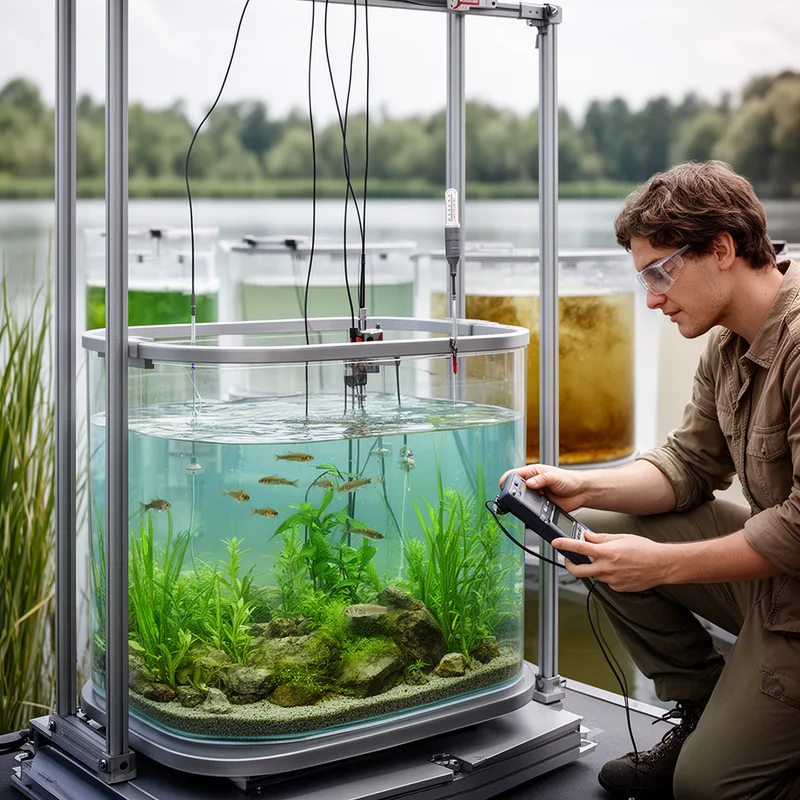
mesocosm


 1
9.9
- noun
- /ˈmɛzoʊˌkɒzəm/
- Specialized
- Collectively, these scaling problems complicate interpretation, comparison, and extrapolation of findings from mesocosm experiments.
- mesocosm experiments
- mesocosm studies
- scale in mesocosm
Examples
-
To what extent can depth-scale effects observed in these mesocosm studies be extrapolated to nature?
Academic text (2003) -
For a given question and system, an "experimental window" of scale, in which mesocosms exhibit realistic ecological dynamics, can often be empirically determined.
Academic text (2003) -
Only one size of marsh mesocosm was used in the studies.
Academic text (2003) -
Three replicates of each mesocosm type were used in experiments.
Academic text (2003) -
Unique to this study, however, were the dramatic effects of mesocosm size, shape, and experimental duration on fish growth rates (Figure 9).
Academic text (2003) -
We tested our hypothesis for scale effects on among-system variability using data from planktonic-benthic mesocosm experiments.
Academic text (2003) -
The MEERC mesocosms were derived from and intended to serve as models of Chesapeake Bay ecosystems.
Academic text (2003) -
Fifteen cylindrical mesocosms were constructed, with five distinct dimensions, three volumes, and three replicates per dimension (Figure 5).
Academic text (2003) -
We found that in plankton-dominated mesocosms this "boom-bust" bloom cycle was substantially damped with continual addition of nutrients.
Academic text (2003) -
The researchers conducted tests in a series of mesocosms to measure the effects of pollutants on aquatic life.
How Natural
- Specialized
103
3.4

- Specialized
1
9.9
26
3.5
- Specialized
14
3.9
Surface Forms
Morphology
mesocosm = cosmos (semi-transparent) = meso + cosm + meso
The formation 'meso-' (middle/medium) + 'cosm(s)' (world/universe) gives 'middle-scale world' which suggests a medium-scale experimental system, but the specific technical meaning (a controlled experimental environment) is specialized and not fully predictable by a general B1 learner.
Etymology
Mesocosm comes from the Greek parts meso- meaning 'middle' and -cosm from cosmos meaning 'world'. A mesocosm is a 'middle world' — a medium-sized, controlled place between a tiny lab system called a microcosm and the whole natural world, the macrocosm, which is why scientists use mesocosms to study how nature works while still keeping control.