

mass-action principle
- noun
- /ˈmæsˌækʃən ˈprɪn.sə.pəl/
- Specialized
- Many neuropsychologists once subscribed to the mass-action principle when explaining complex cognitive deficits after brain injury.
Examples
-
The mass-action principle suggests that the brain's cortex functions as a unified whole rather than as isolated parts.
-
Research has challenged the mass-action principle, showing that certain areas of the cortex are specialized for different tasks.
-
The mass-action principle suggests that brain regions collaborate.
-
According to the mass-action principle, learning involves multiple areas of the brain.
-
Many neuropsychologists once subscribed to the mass-action principle when explaining complex cognitive deficits after brain injury.
-
Research has challenged the mass-action principle, showing that certain areas of the cortex are specialized for different tasks.
-
The mass-action principle suggests that the brain's cortex functions as a unified whole rather than as isolated parts.
Synonyms
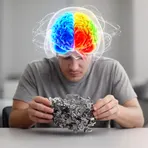
Large areas of the brain work together for complex tasks
Surface Forms
Morphology
mass-action + principle
A learner who knows 'mass' (a large quantity) and 'action' (acting) together with 'principle' (a rule) can reasonably infer this refers to a rule about many elements acting together, so the overall idea is partially recoverable from the parts. However, the term 'mass-action' is a technical, discipline-specific compound whose precise neurological implication (coordinated cortical function) is specialized and not fully predictable for a B1 learner without exposure.
Etymology
Mass-action principle comes from the image of a large mass making an action together—like a crowd all pushing a heavy cart so it moves. That's why it describes the idea that large parts of the brain 'work together' as one rather than each part working alone.

