
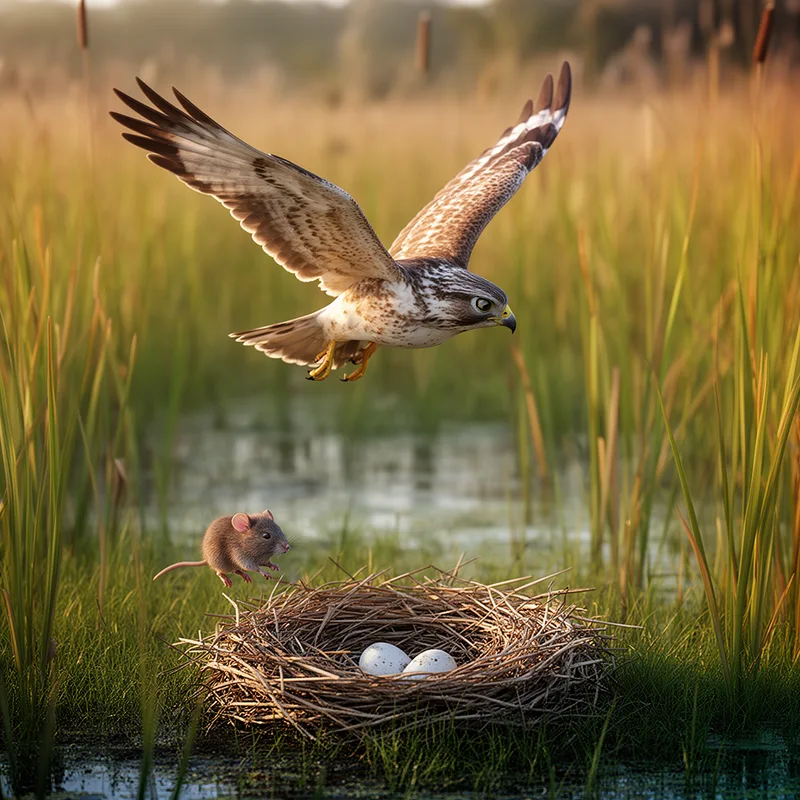
marsh hawk
- noun
- /mɑrʃ hɔk/
- Specialized
- The marsh hawk is known for its distinctive hunting style, often seen hovering above marshes.
Examples
-
While watching the wetlands, we spotted a marsh hawk gliding gracefully overhead, searching for food.
-
Over the cypress trees that walled the swamps, I saw a marsh hawk lift itself and float downward, probably to pluck some unwary prey.
Fiction book (1995) -
During our hike, we were excited to see a marsh hawk perched on a fence post, watching the tall grasses for movement.
Synonyms


 1
8.1
1
8.1
A hawk that hunts small animals over marshes and fields

A medium-sized hunting bird that lives in marshes and open fields
A medium bird of prey with long wings and tail that flies low to hunt over marshes and open land
A medium-sized bird of prey that hunts low over fields and marshes
Surface Forms
Morphology
The compound 'marsh hawk' is directly built from 'marsh' (a wetland) and 'hawk' (a bird of prey), so its meaning—a hawk associated with or living in marshes—is transparently compositional. This noun+noun naming pattern for species is common cross-linguistically and follows straightforward English compounding, so a B1 learner who knows both constituents can infer the MWE's meaning.
Etymology
The name marsh hawk comes from where this bird lives and hunts: marsh is low, wet ground and hawk is a bird that catches other animals. Picture it flying low over the reeds and nesting by ponds, and that image explains why the name means this kind of bird.