

marked-up
 1
5.6
1
5.6

- adjective
- /ˈmɑrkɪd ʌp/
- He prefers reading marked-up versions of books to see the author's notes and changes.
Examples
-
You have your supplies drawer that holds your extra pens, a stapler, and an old marked-up AP stylebook from your junior year PR writing class.
Blog text (8) -
The teacher returned my marked-up essay with helpful comments and corrections.
-
If it's a little bit marked up, I don't really mind that.
-
Use the marked-up outline to create detailed note cards.
Blog text (3) -
These marked-up pages can then be saved and shared with students via e-mail, a number of bookmark tools, or in a blog.
Academic text (2009) -
A copy of "The Art of Reasoning" was on every desk, and my very marked-up copy is in the bookcase behind me as I write this.
Blog text (1) -
All these books are dog-eared and marked up, with loosened bindings; booksellers sometimes facetiously describe their condition as "much loved."
Blog text (13) -
In the intervening two weeks, I have to carefully examine the copy editor's marked-up manuscript, approve or veto their changes, make any necessary changes of my own, and double-check everything.
Blog text (10) -
Many students find it useful to study from marked-up handouts that highlight important concepts.
Synonyms
 3
6.4
3
6.4
Marked with many corrections and edits
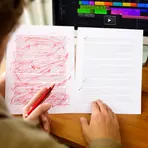
Changed to make a text or film clearer and more correct
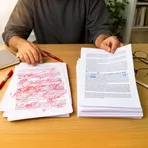
Edited to make a text or plan better
How Marked

Surface Forms
Morphology
marked-up = mark up (transparent) = mark + up + ed
Directly formed from the phrasal verb 'mark up' in its past-participial/adjectival form, so the meaning 'annotated or altered' follows straightforwardly.
Etymology
The word marked-up comes from mark ('a sign or note') and up, a simple way to think of 'add marks'. It originally meant a paper that has notes, corrections, or comments on it, so a 'marked-up' document shows what to change or check.