
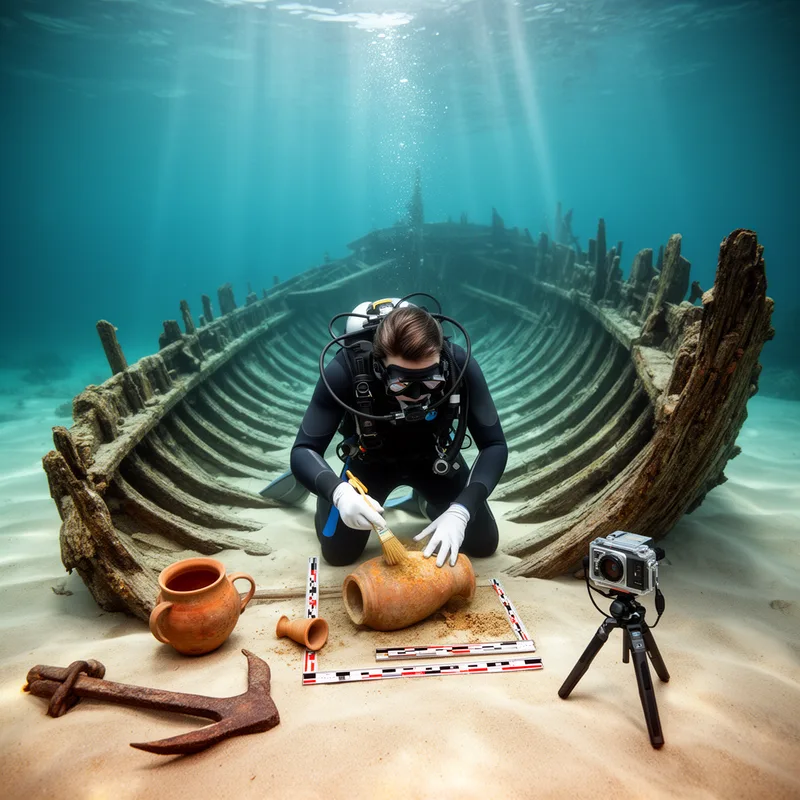
marine archeology


 1
6.2
1
6.2
- noun
- /mɚˈin ɑrˈkiːəˌlədʒi/
- Specialized
- Through marine archaeology, researchers can uncover secrets of the past hidden beneath the ocean's surface.
Examples
-
"These boats—two very different boats—have attracted a lot of popular interest for marine archaeology," says Cui.
Academic text (2011) -
Holds a degree in marine archaeology from the University of North Carolina.
Fiction book (1999) -
"Receiving the kind of money we did is almost unheard of in the world of marine archaeology."
Academic text (2006) -
And over the past two weeks, he's sent me dozens of unreadable books on marine archaeology and enough fiowers for a funeraI, and these missives, almost like love letters.
-
Photo (color): Project Director Marek Jasinski says that the funding his team received to perform the world's first deep-sea scientific excavation "is almost unheard of in the world of marine archaeology."
Academic text (2006) -
marine archaeology helps us understand ancient civilizations by studying shipwrecks and submerged artifacts.
-
Students interested in marine archaeology learn about historical shipwrecks and how to recover artifacts from underwater sites.
Synonyms

A study of people's past using objects found under water, like shipwrecks
Surface Forms
Morphology
The meaning is directly derivable from 'marine' (related to the sea) combined with 'archeology' (the study of past human activity): together they denote archaeology concerning the sea/underwater. This noun–noun compositional pattern is regular in English and across many languages, so a B1 learner who knows both constituents would readily infer the meaning.
Etymology
Marine archeology comes from a simple image: marine means the sea and archeology is the study of old human objects, so imagine people diving to dig up shipwrecks, pots and bones from the sea floor. That's why it means 'the study of the past through underwater places and finds'.