
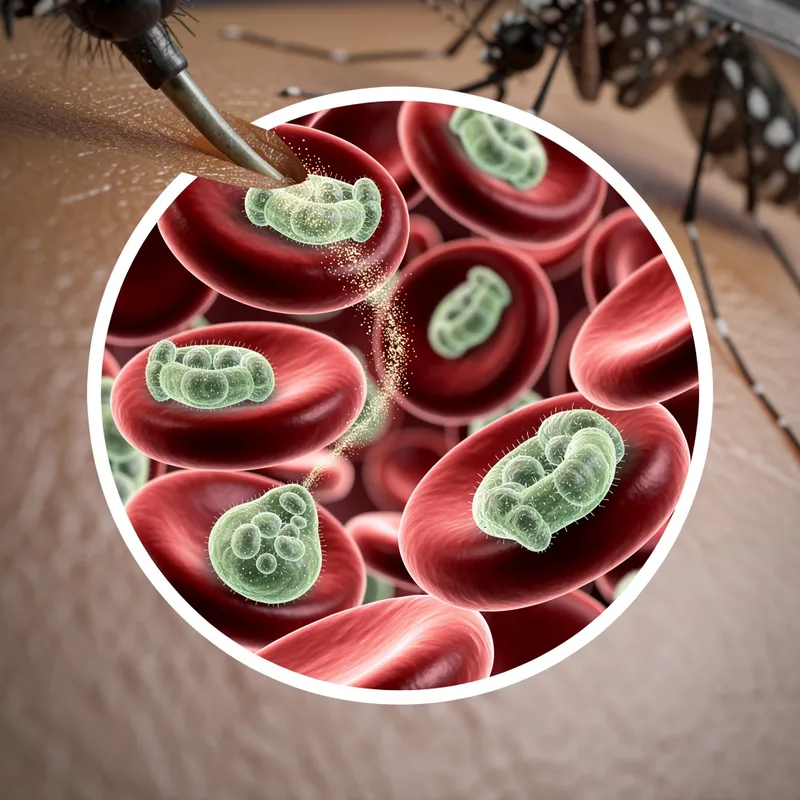
malaria parasite
 1
4.1
1
4.1

- noun
- /məˈlɛəriə ˈpærəˌsaɪt/
- Specialized
- The malaria parasite is believed to have been introduced to a handful of highland valleys in the 1800s because there are no records of it before that time.
- mosquitoes carry the malaria parasite
- malaria parasite Plasmodium
- infected with the malaria parasite
Examples
-
During each antenatal visit, we performed physical examinations and blood smear examinations for malaria parasites.
Academic text (2013) -
Mutations can make red cells inhospitable to the malaria parasite in a variety of ways: by changing the structure of the hemoglobin molecule, by reducing the amount of hemoglobin each cell carries, or by changing the way the red cell breaks down sugars.
Academic text (1992) -
The malaria parasite is notorious for developing resistance to whatever drugs are used for its treatment.
Blog text (34) -
With wider use of antimalarial drugs, the malaria parasite also began to change.
Academic text (1992) -
Because malaria parasites reproduce very fast, their DNA evolves quickly.
-
Mosquito Anopheles gambiae: it's the female of the species that carries the malaria parasite.
Academic text (2012) -
In Latin America, where malaria transmission is low and mostly unstable, Plasmodium vivax is the most prevalent malaria parasite species.
Academic text (2013) -
Higher temperatures also affect the malaria parasite itself, reducing its development time and making mosquitoes infectious more quickly (Gilles 1999).
Academic text (2009) -
During the first half of the war, civilian laboratories had tested more than 6,000 new drugs on malaria parasites and sent the promising compounds to the panel on clinical testing for trial in humans.
Academic text (1994) -
Following an infectious mosquito bite, the malaria parasite goes first to the human liver and then moves into the blood.
Synonyms

A parasite that causes malaria in humans and spreads through mosquito bites
Surface Forms
Morphology
The phrase is a straightforward noun–noun compound: combining 'malaria' (the mosquito‑transmitted disease) with 'parasite' (an organism that lives off a host) yields a parasite that causes or carries malaria. This compositional, encyclopedic relation is cross‑linguistically common and should be immediately understandable to a B1 learner who knows both constituents.
Etymology
Malaria parasite combines the word malaria, the disease, and parasite, a tiny living thing a mosquito puts into your blood and that makes you sick. So it means 'the organism that causes malaria'.