
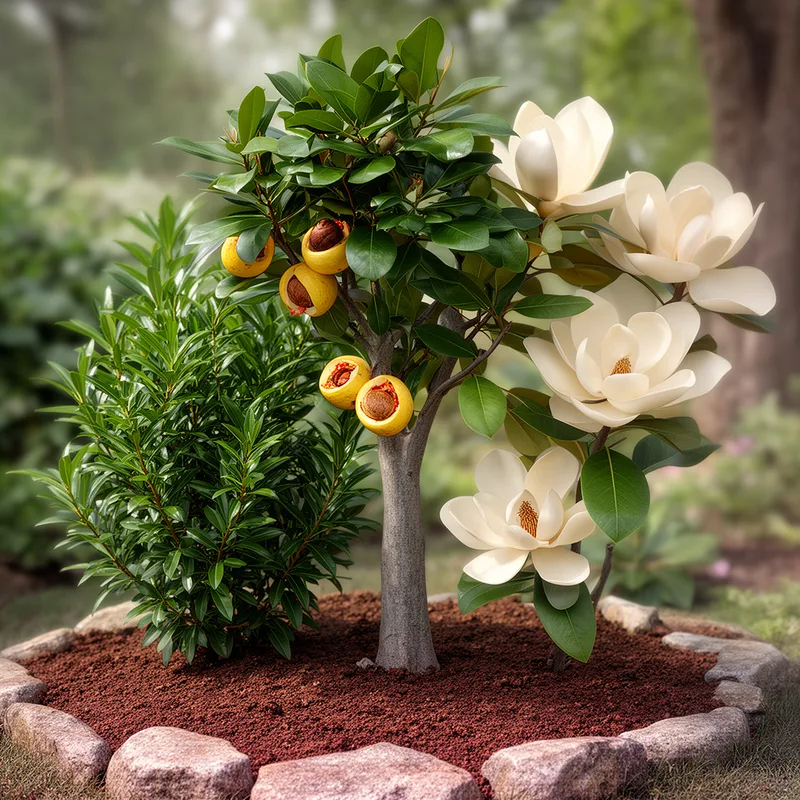
magnoliid dicot family
- noun
- /mæɡˈnoʊliɪd ˈdaɪkɒt ˈfæmɪli/
- Specialized
- Scientists study the magnoliid dicot family to understand the early evolution of flowering plants.
Examples
-
Some spices, such as nutmeg and bay laurel, belong to a magnoliid dicot family.
-
The magnoliid dicot family includes many ancient plant species.
-
The magnoliid dicot family includes many plants that are considered living fossils by botanists.
-
Are there any members of the magnoliid dicot family in this garden?
-
Scientists study the magnoliid dicot family to understand the early evolution of flowering plants.
-
The magnoliid dicot family includes many plants that are considered living fossils by botanists.
-
Some spices, such as nutmeg and bay laurel, belong to a magnoliid dicot family.
Surface Forms
Morphology
The meaning is compositionally derived: 'magnoliid' specifies a subgroup/type, 'dicot' identifies the plant class (two embryonic leaves), and 'family' denotes a taxonomic grouping, so the phrase denotes a taxonomic family of magnoliid dicots. Although 'magnoliid' is technical vocabulary that many B1 learners may not know, if a learner does know the constituent meanings the overall sense is directly predictable from standard noun-modifier + noun + noun composition.
Etymology
Magnoliid dicot family takes its name from magnoliid (plants like magnolias), dicot ('two seed leaves'), and family ('a group'). So the phrase gives the image of a group of magnolia-like, two-seed-leaf plants and is used for a family of early flowering plants.

