
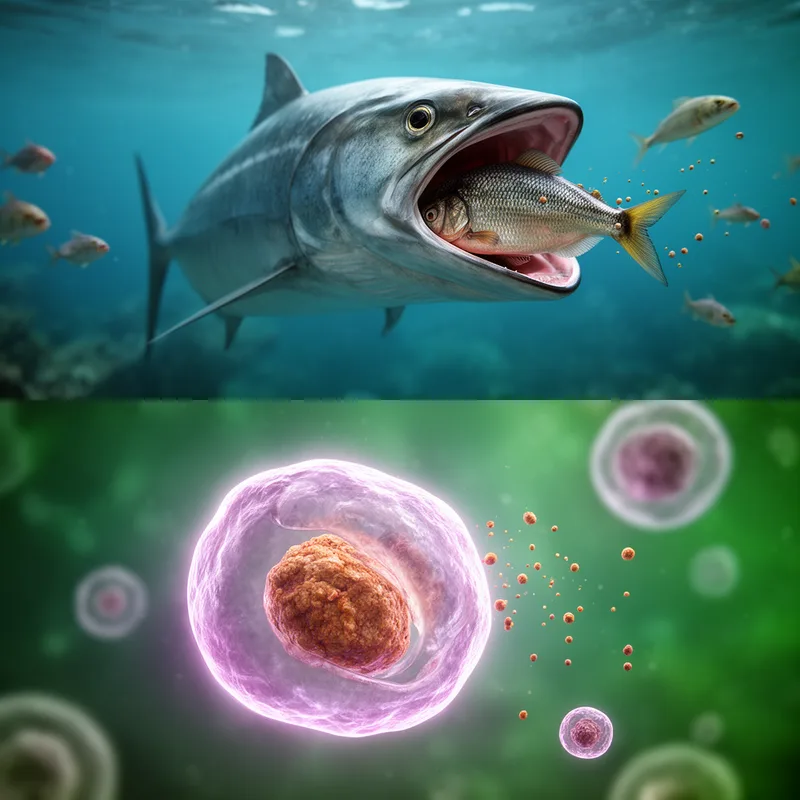
macrophagic
- adjective
- /ˌmækroʊˈfeɪdʒɪk/
- Specialized
 :
macrofágico
:
macrofágico
- Some fish species are considered macrophagic because they consume large pieces of food.
Examples
-
Researchers observed that the macrophagic cells quickly engulfed the large particles introduced into the sample.
-
The macrophagic behavior of these organisms allows them to process bigger prey than others in their environment.
-
The macrophagic cells play a crucial role in the immune response.
-
In the lab, we studied macrophagic behavior in certain species.
-
The researchers found that the macrophagic cells ingested larger particles than their counterparts.
-
Some species of marine life exhibit macrophagic feeding habits, allowing them to consume substantial amounts of prey.
-
The study focused on macrophagic organisms that are capable of ingesting and processing large food items.
Synonyms
A cell that can swallow and digest bacteria and small particles
Surface Forms
Morphology
macrophagic = macrophage (transparent) = macro + phage + ic
The adjective is a regular technical derivative of macrophage with -ic, so the meaning is straightforward if the base noun is known.
Etymology
Macrophagic comes from the Greek parts macro- meaning 'large' and -phagic from phagein meaning 'to eat'. It describes animals or cells that feed on large pieces of food or prey, so the word literally means 'eating big things'.

