
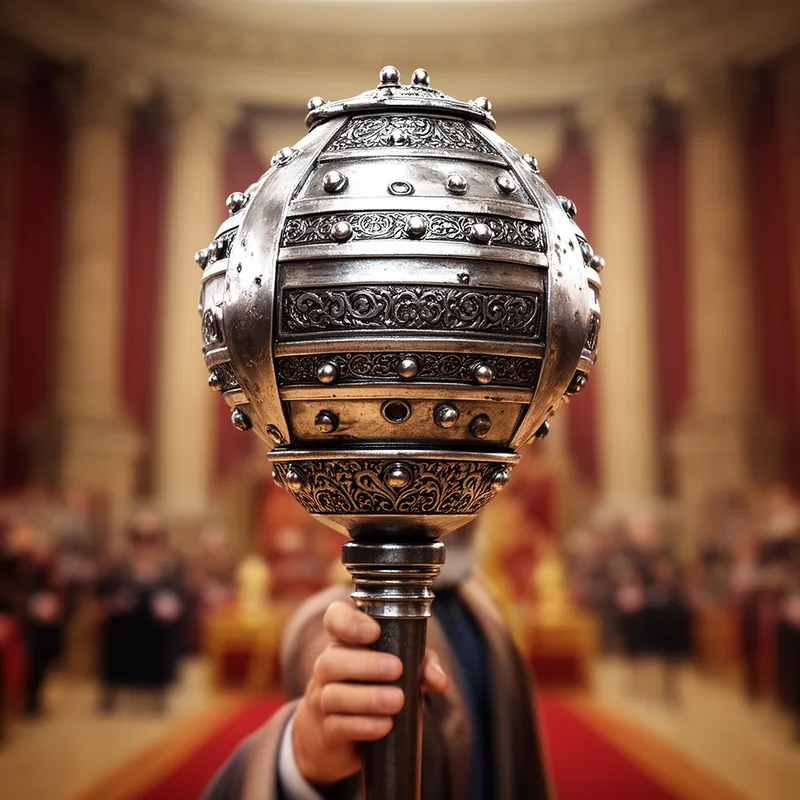
macehead
- noun
- /ˈmeɪsˌhɛd/
- During the ceremonial event, the leader held the macehead high to symbolize authority and strength to the gathered crowd.
Examples
-
PHOTO (BLACK & WHITE): Figure 5. Drawing of decorated star-shaped macehead from Rogaland County (after Bakka 1973, 173, fig. 12).
Academic text (2000) -
In the Neolithic period, an association between snake and woman is indicated both in rock art and on decorated maceheads.
Academic text (2000) -
The maceheads are thought to be weights for digging sticks; they may also have been used by women in food collecting (Vinsrygg 1979, 1987).
Academic text (2000) -
Such interaction is supported by the discovery at Hasanlu IVB of the macehead of Assuruballit, mentioned above, as well as several cylinder seals carved with scenes of animals in a landscape setting that best match Middle Assyrian seal designs.
Academic text (1991) -
In this hypothesis, the glass vessels and the bowl of Kadashman-Enlil could have both been brought to Hasanlu in period IVB as heirlooms from Assyria, perhaps even together with the macehead of Assur-uballit.
Academic text (1991) -
The archaeologists discovered a beautifully crafted macehead that featured intricate designs and represented the power of the ancient rulers.
-
In ancient times, warriors often used a heavy macehead to strike their opponents in battle, making it a feared weapon.
Surface Forms
Morphology
Etymology
The word macehead comes from mace, a heavy club or ceremonial staff, and head, which means 'top' or 'end'. So the macehead is the heavy top used for hitting in battle or as a symbol of office.

