
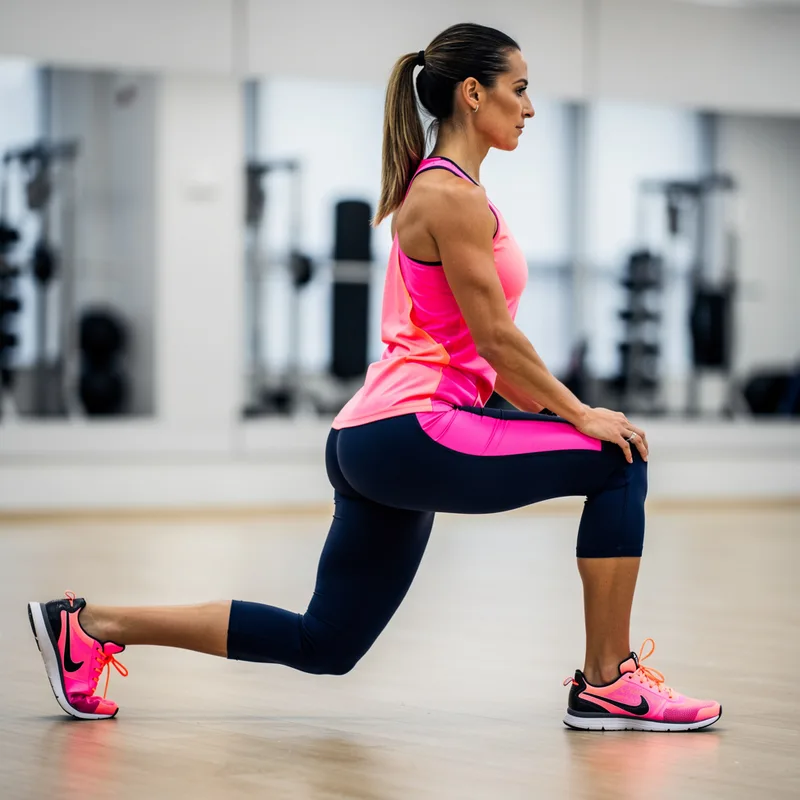
lunge
 8
3.2
8
3.2

- noun
- /lʌndʒ/
- Specialized
- Side, forward, and reverse lunges are ideal for improving glute strength and getting the rear end bigger.
- forward lunge
- reverse lunge
- walking lunges
Loading YouTube…
Watch on YouTubeSo I'll do walking lunges, reverse lunges, step UPS, leg press.
- So I'll do walking lunges, reverse lunges, step UPS, leg press.
- So when I say I love doing lunges, I love doing crunches.
- I do a lot of lunges, heavy suitcase carry lunges.
- OK, then they're going to go straight into alternating jump lunges.
- And he's put me through the paces and he says, OK, do walking lunges.
- So lifting weights and I have things I do with my like I can do squats and lunges in in a hotel room.
- So no matter what hell or hot water, I'm doing my walking lunges.
- So we typically talk about box jumps or jumping lunges or any kind of activity that has a jump factor in it.
Examples
-
I plan to include lots of planks, squats, and lunges, and do lots of interval walking.
Blog text (12) -
Start in a lunge position with the left leg on a low step.
Blog text (26) -
Get into a lunge position with your left leg in front.
-
Step forward and lower your body into a lunge, with your rear leg barely touching the floor.
Blog text (23) -
A more challenging way to come out of the lunge is to stand up on the leg you lunged onto.
Blog text (20) -
I do a lot of lunges, heavy suitcase carry lunges.
-
Squats and lunges can require a lot of balance and coordination, and for people just starting out, certainly older people can have issues with that.
-
Testing the footing to be sure he had guessed right, Riker started a series of stretches and lunges.
Fiction book (1992) -
The first season began with teacher-led warm-up exercises, which included lunges, arm curls, underhand throwing motions, and a variety of locomotor skills.
Academic text (2002) -
To improve your balance, practice your lunge by stepping forward and bending your front knee.
How Strengthening

Surface Forms
Etymology
Lunge (exercise) also follows the same root meaning 'long' or 'to make longer', because you step forward and stretch one leg out. So the exercise is called a lunge as it makes a long forward position that strengthens your legs.