

luggage van
- noun
- /ˈlʌɡɪdʒ væn/
- UK
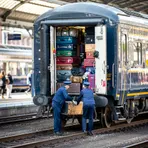
- After checking in, she watched her suitcases being stored in the luggage van of the train.
Examples
-
At the station the gold was loaded into the luggage van of the Folkestone train... for shipment to the coast and from there to the Crimea.
-
The porters carefully loaded the passengers' bags into the luggage van before the train departed.
-
- I was in the luggage van.
-
No one's allowed to ride in the luggage van save Burgess himself as guard.
-
And if that ain't bad enough, they've gone and fitted a lock on the luggage van door.
-
Passengers can place their bags in the luggage van while they find their seats in the train.
Synonyms

 6
2.5
6
2.5

A vehicle on railway tracks that carries people or goods
 5
3.0
5
3.0
A train car that carries passengers' luggage
 3
4.8
3
4.8
A closed vehicle on a train used to carry luggage or goods
 1
2.3
1
2.3
A vehicle that runs on tracks and carries people or goods
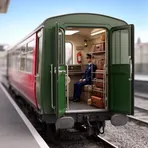
A carriage at the end of a train where the guard sits and luggage is kept
How Big

Surface Forms
Morphology
The meaning is directly and transparently derived from combining 'luggage' (suitcases and travel bags) with 'van' (a vehicle or carriage for carrying goods), forming a noun–noun compound that denotes a vehicle/carriage for luggage. This compositional pattern is commonplace and cross-linguistically familiar, so a B1 learner who knows both constituents would readily infer the MWE's meaning.
Etymology
Luggage van comes from old trains where a separate car held passengers' bags and trunks. Porters packed the bags into the van, so the image of luggage inside the van gave the name, and today luggage van means 'a train car for passenger luggage'.