
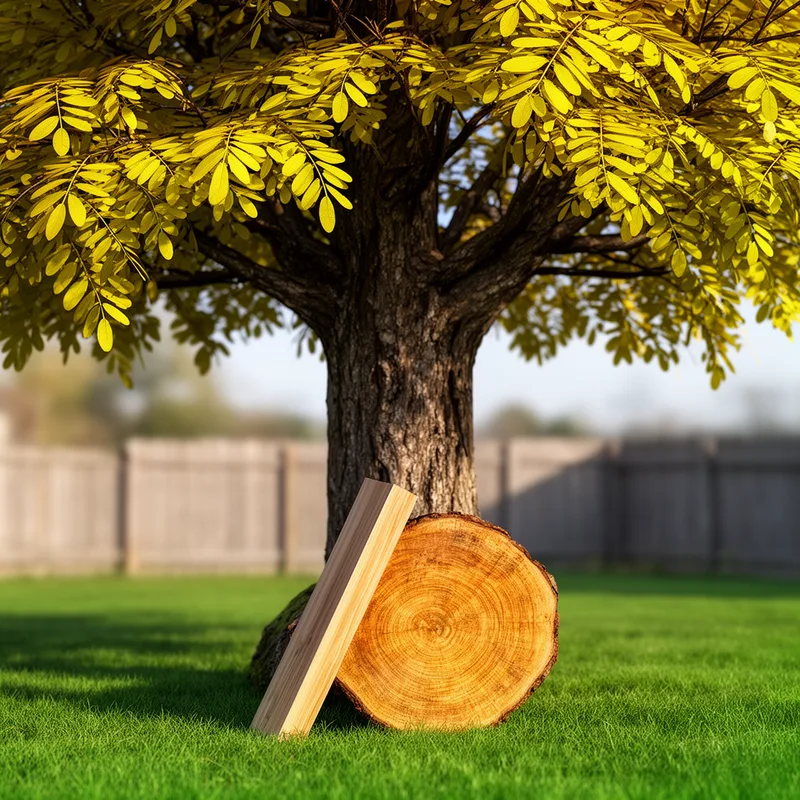
locust tree


 1
5.5
1
5.5
- noun
- /ˈloʊkəst tri/
- US
- In the week following my PV installation, I had branches from my honey locust tree in my front yard snapped and the young aspen in my backyard broken in two.
- a black locust tree
- an old locust tree
Examples
-
I followed him to a wooden bench under a locust tree and sat down beside him.
-
Spring was blossoming on the sweet locust trees.
Fiction book (1990) -
We added two new honey locust trees.
Blog text (20) -
Opposite page, left: Black locust trees make a stand in Manhattan's Riverside Park.
Academic text (2010) -
The locust tree, at eye level, swam in a silvery fog.
Fiction book (1990) -
They presently walked under an enormous honey locust tree that leaned over the road.
Fiction book (1997) -
The stars had disappeared and the sky had lightened, and I could see the skinny, fernlike locust trees that lined the driveway.
Fiction book (1991) -
She delighted in the towering oaks, locust trees, and scattered dogwoods and crab apples.
Fiction book (2000) -
Leaning back against the trunk of an old locust tree, I've got the best seat in the house this morning.
-
Birds chirped outside the window in the branches of the flowering locust tree.
Synonyms
 3
4.6
3
4.6
A strong tree with very hard wood used for fence posts
 1
8.6
1
8.6
A tall North American tree with long twisted seed pods and hard reddish-brown wood
A large thorny tree with hanging clusters of fragrant white flowers

A tall North American tree often with thorns, strong wood, and long twisting seed pods
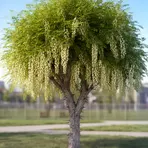
A large tree with thorns, many small leaves on each branch, and hanging white flowers

A swamp tree of the southern United States with short oval seed pods and dark heavy wood called water locust
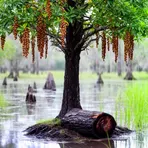
A tree that grows in the swamps of the southern United States with short oval pods and dark heavy wood
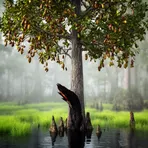
A tree that grows in southern swamps with short oval pods and strong dark wood
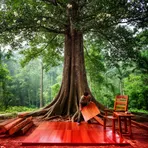
A large tropical American tree with very hard wood used for furniture and flooring
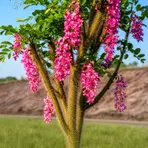
A large bush or small tree with rough stiff hairs on its stems and clusters of pink flowers
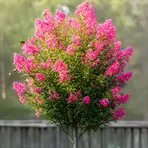
A large shrub or small tree with bristly stems and clusters of pink flowers

A small tree in the southeastern United States with rough bark, pink flowers and sticky branches
Surface Forms
Morphology
The compound is fully compositional: 'locust' (a type of tree or its wood) combined with 'tree' yields the straightforward meaning 'a tree of the locust species.' While 'locust' can also refer to an insect, a B1 learner who knows the tree/wood sense of 'locust' will readily infer the MWE's meaning, and this naming pattern is cross-linguistically common.
Etymology
Locust tree may get its name from the long, bean-like pods that made early people think of the insect locust mentioned in the Bible, which was eaten with honey. That's why the name stuck to trees like the honey locust and black locust, which are known for their hard wood and summer shade.