
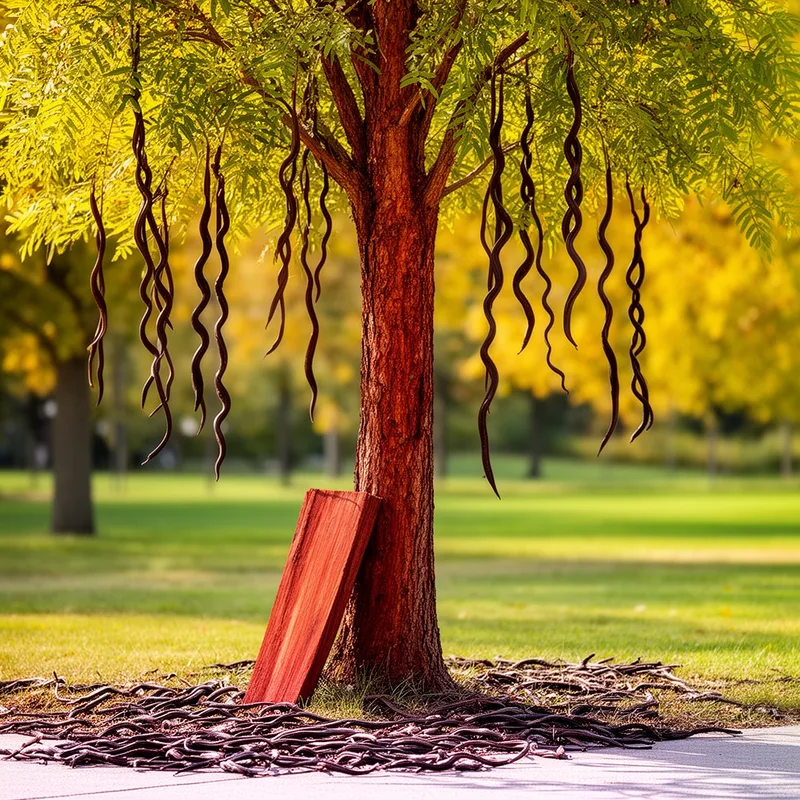
honey locust


 1
8.6
1
8.6
- noun
- /ˈhʌni ˈloʊkəst/
- US
- In the park, a few mature honey locust trees provide shade with their broad canopies.
- honey locust tree
- honey locust pods
Examples
-
The only things that are in here currently are the shade master honey locust, which was here when we moved in, Red Point Maple that we planted maybe three seasons ago now.
-
The wood from the honey locust is known for being hard and durable, making it suitable for furniture.
-
We added two new honey locust trees.
Blog text (20) -
Like carob, honey locust does not fix nitrogen.
Blog text (1) -
Honey locust pods are large and full of sugars in good varieties.
Blog text (1) -
They presently walked under an enormous honey locust tree that leaned over the road.
Fiction book (1997) -
Trees can be planted in pastures for nuts, fruit, or even animal fodder in the case of honey locust and its nutritious pods.
Academic text (2005) -
Other experiments on black walnut/honey locust silvopastures are underway with collaborators at Virginia Tech University, in nearby Blacksburg, Virginia.
Academic text (2005) -
These species, along with perennial grains and honey locust, offer a respectable place to start for a perennial carbon-sequestering staple crop system for the cold world.
Blog text (1) -
The honey locust tree produces long, twisting seed pods that are attractive to wildlife.
Synonyms

A tall North American tree often with thorns, strong wood, and long twisting seed pods
Surface Forms
Morphology
The compound is directly compositional: 'honey' modifies 'locust' to indicate a type of locust tree associated with honey-like qualities (e.g., sweet pods or honey-coloured aspects). As a straightforward noun–noun species name, its meaning (a particular kind of locust tree) is derivable by a B1 learner who knows both constituent meanings.
Etymology
Honey locust gets its name from the tree's long, twisting seed pods that contain a sweet, honey-like pulp. Early settlers called pod-bearing trees 'locusts', so honey, meaning the sweet pulp, plus locust, meaning a pod tree, gives the name and explains why the phrase refers to this particular tree.