

living stone
- noun
- South African
- When the living stone blooms, it produces a delicate yellow or white flower.
Examples
-
The living stone survives harsh climates by mimicking surrounding pebbles to avoid being eaten.
-
Many collectors prize the unusual appearance of living stone plants in their succulent gardens.
-
The living stone is a unique plant.
-
Many gardeners love living stones for their beauty.
-
Many collectors prize the unusual appearance of living stone plants in their succulent gardens.
-
The living stone survives harsh climates by mimicking surrounding pebbles to avoid being eaten.
-
When the living stone blooms, it produces a delicate yellow or white flower.
Synonyms


 1
9.9
1
9.9
A small plant with thick leaves that look like stones and yellow or white flowers
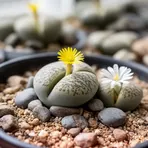
A small plant with thick leaves that looks like a stone and has yellow or white flowers

A small plant with thick leaves that look like stones and a single yellow or white flower

A small plant with thick leaves that look like stones and one yellow or white flower

Small plants from South Africa without stems called living stones that store water

A small plant with thick leaves that look like a stone
Surface Forms
Morphology
The phrase is compositional: 'living' (alive) modifies 'stone' (rock) to signal something that looks like a stone but is alive, so a learner can infer an organism—likely a plant—resembling a rock. This is a literal descriptive name rather than an idiom, so its basic meaning is directly derivable from the constituents even if the precise botanical genus requires extra knowledge.
Etymology
Living stone gets its name because the small plant has thick leaves that look like a stone, so it seems to be a 'living' rock. That's why the name fits: looking like a stone helps the plant avoid being eaten and survive.