

leishmaniasis
 1
9.9
1
9.9

- noun
- /liːʃməˈnaɪəsɪs/
- Specialized
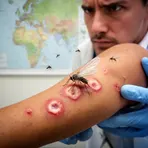
- PHOTO (COLOR): Cutaneous leishmaniasis, a skin form of the disease transmitted by sand flies.
- cutaneous leishmaniasis
Loading YouTube…
Watch on YouTubeDogs are the only host for some diseases like leishmaniasis, which was that paper that we were not responsible for, but I know why they were doing the experiment.
- Dogs are the only host for some diseases like leishmaniasis, which was that paper that we were not responsible for, but I know why they were doing the experiment.
Examples
-
In areas where leishmaniasis is common, many residents seek treatment for painful skin sores.
-
Leishmaniasis and sarcoidosis also have similar characteristics, which can produce a confusing clinical picture.
Academic text (2002) -
And service members deploying for Iraq and Afghanistan today learn a new word for an unusual danger: leishmaniasis.
Academic text (2005) -
Tuberculosis, malaria, and leishmaniasis were endemic, and Chagas' disease was common.
Academic text (1996) -
Sand flies, the vectors of leishmaniasis, will be supplied from colonies at the Walter Reed Army Institute of Research in Silver Spring, Maryland.
Academic text (2005) -
A concern must be that some major causes of illness and death, such as visceral leishmaniasis and African human trypanosomiasis, remain overshadowed and unaddressed.
Academic text (2013) -
Bryceson first suggested that local immune dysfunction was responsible for the unusual prevalence of cutaneous leishmaniasis on the legs in Ethiopia.
Academic text (1994) -
Zinc has been used successfully in the treatment of many skin diseases such as cutaneous leishmaniasis and viral warts, where it was found to be safe, non-costly, and effective therapy.
Academic text (2007) -
Reservoirs and vectors for infectious diseases such as dengue, leishmaniasis, and leptospirosis flourish in slums.
Academic text (2016) -
In addition to malaria, SNEM has monitored and controlled Chagas disease, dengue fever, onchocerciasis, yellow fever (in Amazonia), and leishmaniasis in Ecuador (13).
Academic text (2012)
Synonyms

A disease caused by tiny parasites spread by sandflies that makes skin sores and can affect organs
Compounds


- Specialized
A disease in the Americas that causes sores on the skin and inside the mouth or nose

- Specialized
A disease that causes sores on the skin and on the mouth or nose

- Specialized
An infection that causes sores on the skin and inside the nose or mouth

- Specialized
A disease that causes sores inside the nose and throat, often in Mexico and Central and South America

- Specialized
A disease in Mexico, Central, and South America that causes sores on the skin and inside the mouth or nose
- Indian
A skin disease from sandfly bites in Europe, Asia, or Africa that causes open sores

- Specialized
A severe infection by tiny parasites that attacks internal organs like the liver, spleen and bone marrow
How Severe
- Specialized

- Specialized
- Specialized
1
9.9
- Specialized
 1
7.3
1
7.3
- Specialized
5
5.6
Surface Forms
Morphology
leishmaniasis = Leishmania (opaque) = leishmania + iasis
Formed from a scientific genus name plus the medical disease suffix '-iasis', which is specialized vocabulary unlikely to be understood by an average B1 learner.
Etymology
Leishmaniasis comes from the name of the doctor Leishman and the parasite name Leishmania, plus the ending -iasis which means 'disease'. So leishmaniasis means the disease caused by the tiny parasite Leishmania, which people get from sandfly bites and which causes skin sores or can affect organs inside the body.