
cutaneous leishmaniasis


 1
7.3
1
7.3
- noun
- /kjuˈteɪniəs ˌliːʃməˈnaɪəsɪs/
- Specialized
- The doctor diagnosed him with cutaneous leishmaniasis due to the distinctive ulcers present on his skin.
Examples
-
After visiting areas where sand flies are common, she developed cutaneous leishmaniasis with ulcerative lesions on her arms.
-
Cutaneous leishmaniasis can cause painful sores on the skin that may take months to heal.
-
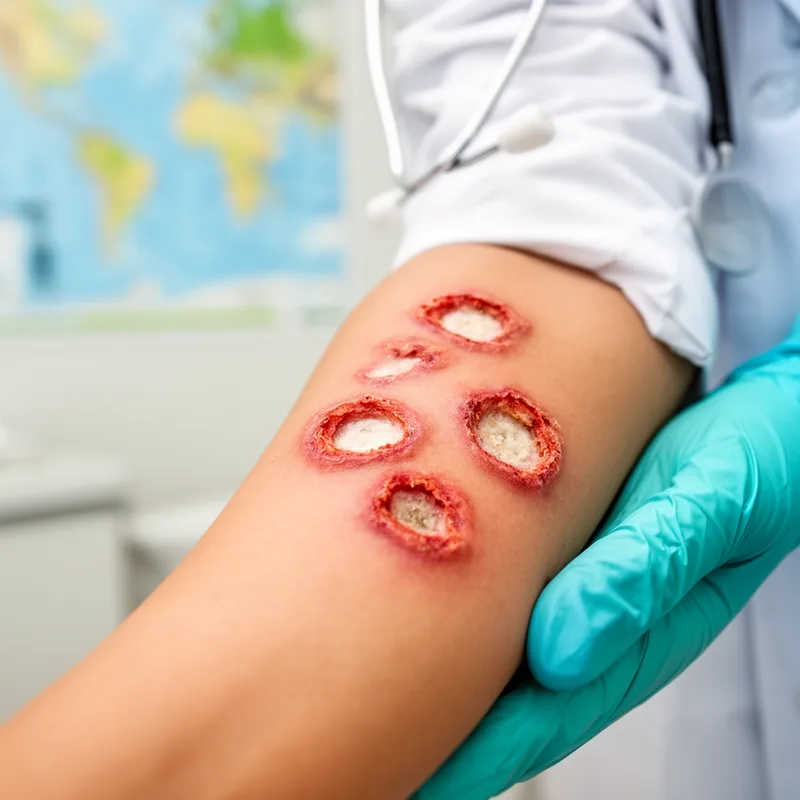
PHOTO (COLOR): Cutaneous leishmaniasis, a skin form of the disease transmitted by sand flies.
Academic text (2005) -
Bryceson first suggested that local immune dysfunction was responsible for the unusual prevalence of cutaneous leishmaniasis on the legs in Ethiopia.
Academic text (1994) -
Zinc has been used successfully in the treatment of many skin diseases such as cutaneous leishmaniasis and viral warts, where it was found to be safe, non-costly, and effective therapy.
Academic text (2007)
Synonyms

A skin infection from tiny parasites in warm countries that makes open sores

A skin disease that causes painful open sores

A skin disease that makes open sores on exposed skin after sandfly bites

An open skin sore caused by a small parasite in hot countries
How Severe
- Specialized

- Specialized
- Specialized
1
9.9
- Specialized
1
7.3
- Specialized
5
5.6
Surface Forms
Morphology
The meaning 'a form of leishmaniasis that affects the skin' is directly and compositionally derived from 'cutaneous' (skin-related) modifying 'leishmaniasis' (the disease). This adjective+noun medical construction is a standard, cross-linguistically common pattern, so a B1 learner who knows both constituents would be able to infer the MWE's meaning.
Etymology
The term cutaneous leishmaniasis names the illness directly: cutaneous means 'of the skin' and leishmaniasis is a disease caused by tiny insects called sandflies that pass on parasites. So the phrase means a disease that causes sores on the skin.