
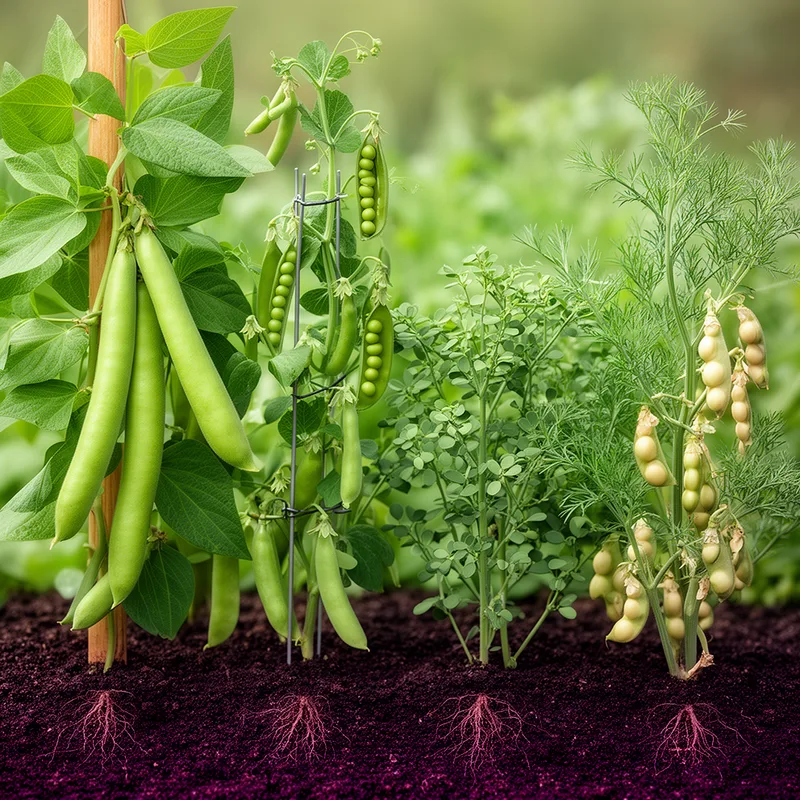
leguminous
- adjective
- /lɪˈɡjuːmɪnəs/
- Specialized
- Farmers often rotate leguminous crops to enhance nitrogen levels in the soil.
- leguminous crops
- leguminous plants
Examples
-
Coffee plantations shaded by leguminous trees in the genus Inga are particularly attractive to the birds.
Academic text (2010) -
The 250 million hectares of leguminous crops currently cultivated worldwide increase nitrogen fixation over preindustrial levels by about 40 Tg(N)/yr.
Academic text (1994) -
Nitrogen fixation in leguminous plants is dominated by a variety of endosymbiotic bacteria.
Academic text (1997) -
We are fertilizing the Earth on a global scale through intensive agriculture, fossil fuel combustion, and widespread cultivation of leguminous crops.
Academic text (2000) -
My own literacy quest was largely founded on my passion for Peanuts—not the leguminous variety, but the Schultz variety.
Academic text (2006) -
McFall-Ngai and Ruby hope they have found a model that will be as useful for exploring animal-bacteria mutualism as the leguminous plant-Rhizobium model has been for plant-bacteria mutualism.
Academic text (1993) -
The planting of leguminous crops (such as soybean and alfalfa) and the combustion of fossil fuels are the second and third most important human activities that increase nitrogen fixation rates. (See figure 6.)
Academic text (1994) -
On the contrary, green manure crops and leguminous cropping patterns can produce higher rice yield as compared to the commonly practiced rice-wheat cropping pattern (Ali et al. 2012).
Academic text (2014) -
At the distance of seven leagues, toward the northeast, at the entry of the Sierra Madre, the mission has San Antonio de Pala, with a church, dwellings, and granaries, and with a few fields where wheat, corn, beans, garbanzos, and other leguminous plants are grown.
Academic text (2000) -
Leguminous plants, such as beans and lentils, play a crucial role in improving soil fertility.
Compounds

Surface Forms
Morphology
Etymology
The word leguminous comes from the Latin word legumen, which meant 'bean' or 'pod'. That is why leguminous describes plants like beans, peas, and lentils, the members of the legume family.

