

latter
 74
2.8
74
2.8

- noun
- /ˈlætər/
- Much of the latter should be done in steps, not all at once.
- the former and the latter
- especially the latter
- the latter, in fact
Loading YouTube…
Watch on YouTubeBecause if it's the latter, that brings me to the third thing.
- Because if it's the latter, that brings me to the third thing.
- And with respect to the latter, that's where Harvey Weinstein fell.
- The former is yellow cards, the latter is the red cards.
- I don't think so, at least the latter.
- Well, according to a poll I ran on X, the latter doesn't seem to be the big priority.
- Like, I mean, obviously you both chose the latter, right?
- So that's the, so there's two and I'm, I'm the latter.
- Most everyone I know I would probably be the latter and so I try to keep that in mind.
- And yeah, I'll often choose the latter specifically because I freaking love this code.
- Well, I don't think the latter follows.
- I think the latter given my theory.
Examples
-
The former is yellow cards, the latter is the red cards.
-
"The former has been hard to find, and the latter is too young for you."
Fiction book (1993) -
Since the former is extremely costly, it is very likely that the latter will be the main choice.
Academic text (1999) -
Without renewed domestic support, the latter would not be supported and the former could not be sustained.
Academic text (1990) -
The former was in his job description; the latter was a matter of personal pique.
Fiction book (1992) -
Men tend to emphasize love over money, suggesting that the latter does not bring happiness.
Academic text (1999) -
Well, according to a poll I ran on X, the latter doesn't seem to be the big priority.
-
Neither conjecture was certain, and the latter was almost certainly false.
Fiction book (1999) -
We might succumb to the temptation to do the latter, to be couch potatoes.
-
In the debate, the former option was more practical, but the latter had greater emotional appeal.
Synonyms


Antonyms

Compounds
 19
5.2
19
5.2
A person who belongs to the Church of Jesus Christ of Latter-day Saints, often called the Mormon Church
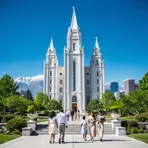
A Christian church started in 1830 by Joseph Smith, based in Salt Lake City
Surface Forms
Morphology
Etymology
Latter comes from an old English word related to later, which means 'after' or 'coming after'. So the latter is the 'second' of two things that were just mentioned.