

to lard
 1
7.7
1
7.7

- verb
- /lɑrd/
- It's the result of a 20-year evolution larded with anti-tort politics.
Examples
-
"Scientific papers" are larded with "may," "might," and "could possibly."
Blog text (23) -
There was plenty of time for Ethold and his followers to lard the queen's treasuries with counterfeit gems and set cave-ins at certain key tunnels in the gemfields.
Fiction book (1993) -
Re: "Scientific papers" are larded with "may" and "might" and "could possibly."
Blog text (23) -
"Scientific papers" are larded with "may," "might," and "could possibly."
Blog text (23) -
They worked overtime to weaken the president's initial recovery act, cutting its size and larding it with ineffective tax cuts.
Blog text (30) -
He does not carry the baggage of a regular scholar but speaks in clear English well larded with quotations in Arabic that display an apparent knowledge of Qur'anic and other texts.
Academic text (2010) -
"Plundering the Pueblos" was larded with colorful descriptions of Pueblo culture, but Collier's point was to promote opposition to the Bursum bill, which had become his first concrete challenge as a professional advocate of Indian policy reform.
Academic text (1994) -
He larded his speech with anecdotes and jokes to keep the audience engaged.
-
The author's latest novel is larded with rich descriptions that bring the setting to life.
-
In her presentation, she larded the main points with relevant data to enhance her argument.
Synonyms
 19
6.1
19
6.1
To add extra details to a story, sometimes making it less true
 19
6.5
19
6.5
To add extra, unnecessary details to make something seem bigger or better
 15
4.2
15
4.2
To make something seem more exciting or important than it really is
 5
9.5
5
9.5
To make something seem more important by adding details or exaggerating
 3
5.5
3
5.5
To add extra details to a story that often make it less true
 2
4.3
2
4.3
To add more details to an idea or story
 2
7.5
2
7.5
To talk or write for a long time about a subject

To interrupt speech or writing by adding short remarks to give variety

To add too many details and ruin something

Make something richer by adding fat or extra things that are not needed
Antonyms


Phrasal Verbs

Compounds


How Embellished

Surface Forms
Etymology
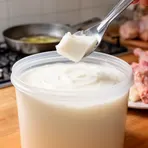
A helpful way to remember the verb lard is to think of the cooking idea of lard—adding fat to make food richer. So when you 'lard' a speech or story, you add extra details like 'fat' to make it richer or more full.