
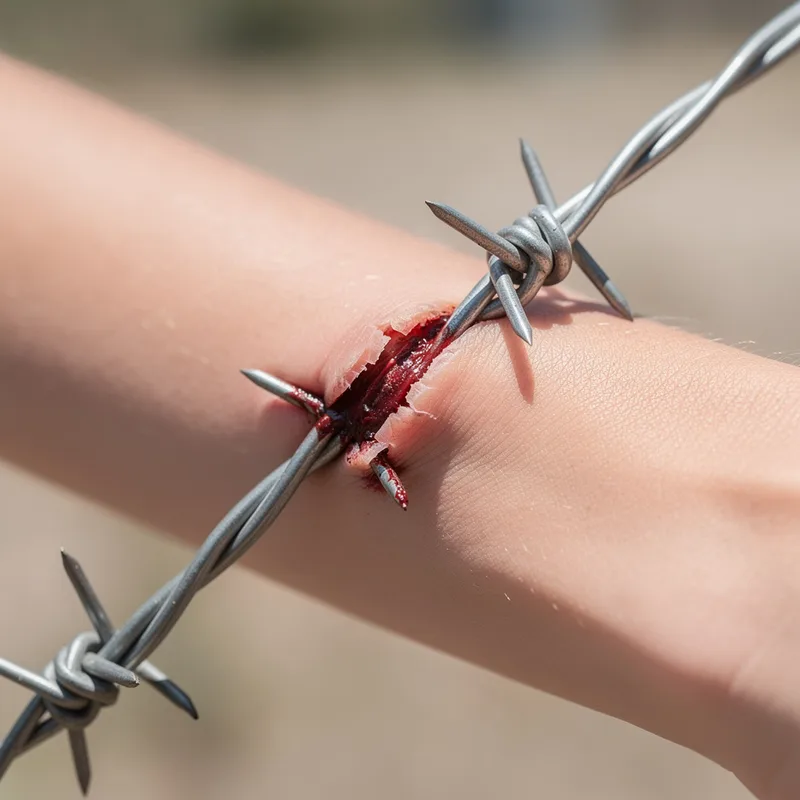
to lacerate
 9
7.5
9
7.5

- verb
- /ˈlæsəˌreɪt/
- NSFW
- The branches of the tree lacerated his skin as he tried to climb through.
- lacerated liver
- lacerated skin
- lacerated spleen
Examples
-
The right side is lacerated and torn."
-
Are you aware I have a partially lacerated liver?
-
Where the skin was not lacerated, it was as soft and pink as her own.
Fiction book (1992) -
The tongue was lacerated in several locations.
Fiction book (1992) -
Both of her legs are severely lacerated.
-
His head had been repeatedly lacerated, and his throat appeared to have been cut.
Blog text (33) -
He'd been severely lacerated in the face and hands and was in stable condition in the hospital.
Fiction book (2001) -
Her son's eyes are closed, his arms lacerated, his chest wounded and crusted with blood.
Fiction book (1996) -
Myrna had cried at the sight of him, lacerated and bruised, his dark face drawn in lines of terrible pain.
Fiction book (1991) -
Blood drips down Jahan's face; he staggers to a nearby makeshift first-aid center, where attendants wash his lacerated back and head with water.
Academic text (1990)
Synonyms
 617
2.3
617
2.3
To cut or hurt someone's body physically
 62
4.1
62
4.1
Cause serious harm to people or things with a sharp object
 21
6.1
21
6.1
To badly cut, tear, or crush and cause a serious physical injury
Antonyms
How Severe
- NSFW
73
7.4
 53
3.0
53
3.0
- NSFW
9
7.5
33
3.5
161
1.1
Surface Forms
Morphology
lacerate = lacer + ate
Although formed with the productive suffix '-ate', the root 'lacer' is not a familiar English base, so the verb meaning 'to tear roughly' is not transparently predictable for typical learners.
Etymology
Lacerate comes from the Latin verb lacerare, which means 'to tear', and you can see the same idea in the word laceration. Imagine sharp metal or glass tearing flesh roughly—so to lacerate is to cut or tear something in a rough, jagged way.