

kist
- noun
- /kɪst/
- Archaic
- A Bronze Age kist was discovered on the hillside, containing pottery and bones.
Examples
-
Many prehistoric burials in Scotland used a kist made of large stone slabs.
-
The archaeologists discovered an ancient kist in the burial site.
-
The archaeologists carefully excavated the ancient kist to study its contents.
-
Many ancient cultures used a kist for their dead.
-
The archaeologists carefully excavated the ancient kist to study its contents.
-
A Bronze Age kist was discovered on the hillside, containing pottery and bones.
-
Many prehistoric burials in Scotland used a kist made of large stone slabs.
Synonyms

 235
3.0
235
3.0

A large stone building or underground room where people put a dead person
 37
9.9
37
9.9
A stone coffin often decorated with carved pictures and writing used in ancient burials
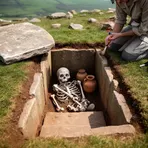
A grave made of stones used in ancient times to hold human bones
Surface Forms
Etymology
Kist in the burial sense comes from the same root cista, which meant 'box', so in old graves a kist is literally a stone 'box' or small coffin used to hold a body.