
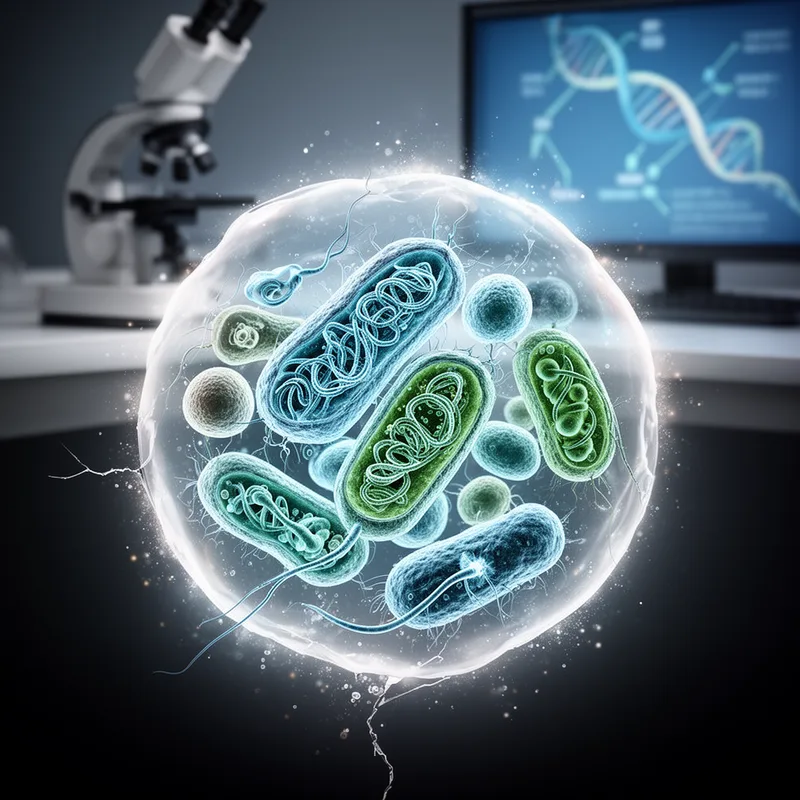
kingdom Prokaryotae
- noun
- /ˈkɪŋdəm proʊˈkɛriəˌti/
- Archaic
- The kingdom Prokaryotae includes organisms like bacteria that lack a cell nucleus.
Examples
-
The kingdom Prokaryotae was once used to classify all prokaryotic organisms, including bacteria.
-
The kingdom Prokaryotae consists of simple, unicellular organisms.
-
Recent advances in genetics have led to the division of the kingdom Prokaryotae into new domains.
-
Textbooks from the 20th century frequently refer to the kingdom Prokaryotae in their classification diagrams.
-
Many scientists study the kingdom Prokaryotae for its unique characteristics.
-
In modern biology, the kingdom Prokaryotae is recognized as a group of unicellular organisms.
-
Research on the kingdom Prokaryotae helps us understand the evolutionary significance of prokaryotic life.
Synonyms


 1
9.9
1
9.9
Single cells that do not have a nucleus, like bacteria
A group of tiny living things like bacteria whose cells have no nucleus

Very small simple living things like bacteria that have no nucleus in their cells
Surface Forms
Morphology
kingdom + Prokaryotae
This is a straightforward compositional taxonomic label: 'kingdom' (a taxonomic rank) combined with the name 'Prokaryotae' denotes the kingdom made up of prokaryotic organisms. If a learner knows the constituent meanings (including that Prokaryotae refers to prokaryotes), the overall meaning is directly derivable, though the taxonomic name itself is specialized and uncommon at B1.
Etymology
Kingdom Prokaryotae gets its name from Greek parts: pro- meaning 'before' and karyon meaning 'kernel' or 'nucleus'. It was used for organisms whose cells do not have a nucleus, so the name literally points to being 'before the nucleus'.