
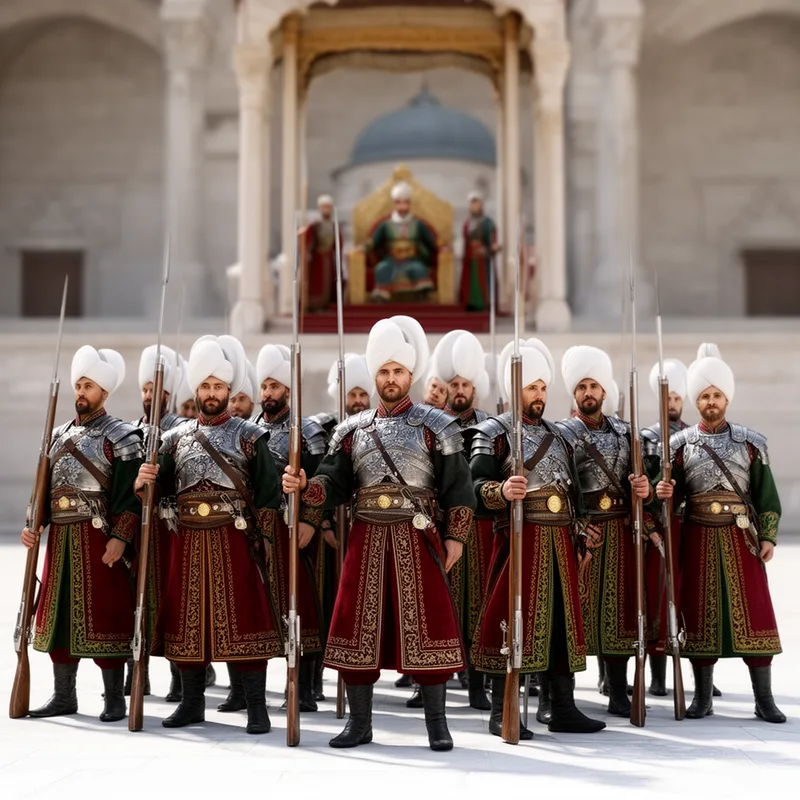
janissary elite
- noun
- /ˈdʒænɪˌsɛri ɪˈlit/
- Specialized
- The janissary elite were highly trained and often wielded great power in the Ottoman court.
Examples
-
The janissary elite played a crucial role in the Ottoman military.
-
Without the janissary elite, the Ottoman military would have struggled to maintain its dominance.
-
Historians debate the origins of the janissary elite and their recruitment methods.
-
Many historians study the janissary elites of the Ottoman Empire.
-
The janissary elite were renowned for their loyalty and discipline in serving the Ottoman Empire.
-
Throughout history, the janissary elite significantly influenced state affairs in the Ottoman court.
-
The rise of the janissary elite helped establish the military strength of the Ottoman Empire.
Synonyms

 258
4.7
258
4.7

A small group of the most powerful or rich people in a society
Antonyms


Surface Forms
Morphology
The meaning is directly compositional: 'Janissary' names a specific Ottoman infantry unit and 'elite' denotes the most powerful or privileged subgroup, so a learner who knows both words can infer 'the distinguished/leading members of the Janissaries' or an elite military group. This straightforward noun+noun combination follows common compositional patterns (and parallels exist in many languages), making the phrase immediately understandable to someone familiar with the constituents.
Etymology
Janissary elite The term comes from the Ottoman Empire, where the word janissary named boys taken from their homes and raised and trained by the ruler to become full-time 'soldiers'. Because these men were specially trained and very 'loyal' to the ruler, the name grew to mean a powerful, trusted military group today.