
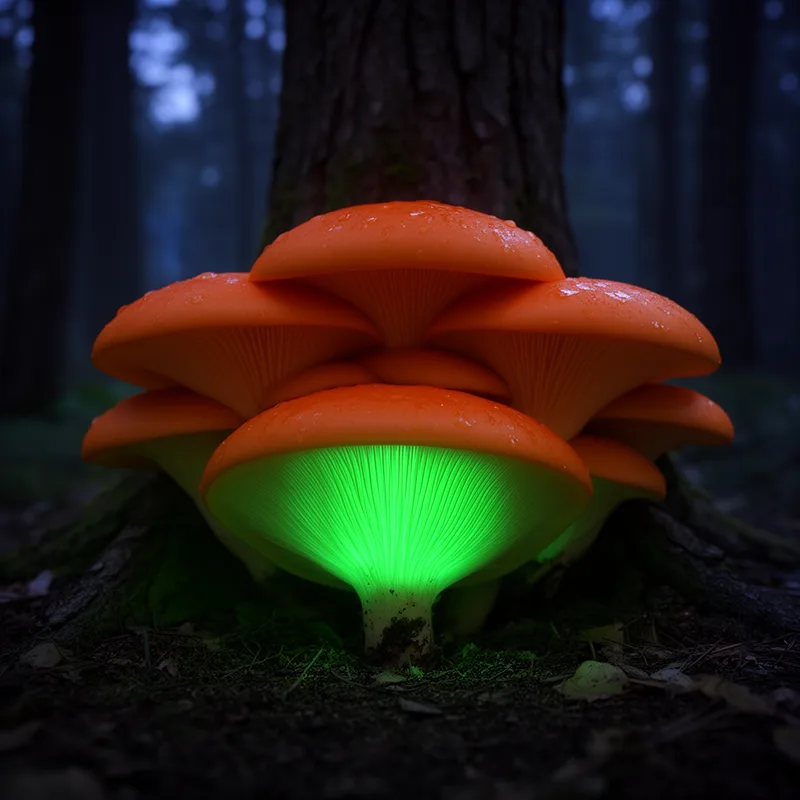
jack-o-lantern fungus
- noun
- /ˈdʒæk oʊ ˈlæn tərn ˈfʌŋ ɡəs/
- US
- At night, the gills of a jack-o-lantern fungus can emit an eerie greenish glow.
Examples
-
The jack-o-lantern fungus is often mistaken for edible chanterelles by inexperienced foragers.
-
You should never eat a jack-o-lantern fungus because it is highly poisonous.
-
The jack-o-lantern fungus can be found in damp, wooded areas.
-
Many hikers mistakenly believe the jack-o-lantern fungi are edible.
-
At night, the gills of a jack-o-lantern fungus can emit an eerie greenish glow.
-
You should never eat a jack-o-lantern fungus because it is highly poisonous.
-
The jack-o-lantern fungus is often mistaken for edible chanterelles by inexperienced foragers.
Synonyms

A large poisonous mushroom with an orange cap that glows at night

A poisonous mushroom with bright orange caps that grows in woods and fields
A large poisonous mushroom with bright orange caps and glowing gills called the Jack-o'-lantern mushroom
How Poisonous


Surface Forms
Morphology
jack-o-lantern + fungus
The form is compositionally built as 'jack-o-lantern' + 'fungus', so a learner who knows 'jack-o-lantern' (the carved glowing pumpkin) and 'fungus' can infer it refers to a fungus associated with or resembling a jack-o-lantern (e.g., orange and glowing). However, 'jack-o-lantern' is a culture-specific lexical item and the specific properties (poisonous, glowing gills) are not fully predictable from the constituents, so the meaning is only partially transparent.
Etymology
Jack-o-lantern fungus gets its name from its bright orange caps and the strange greenish light that sometimes shines from its gills at night, a sight that looks like a tiny lantern or a carved pumpkin. So the name helps you remember that this mushroom has orange tops and can glow in the dark.