
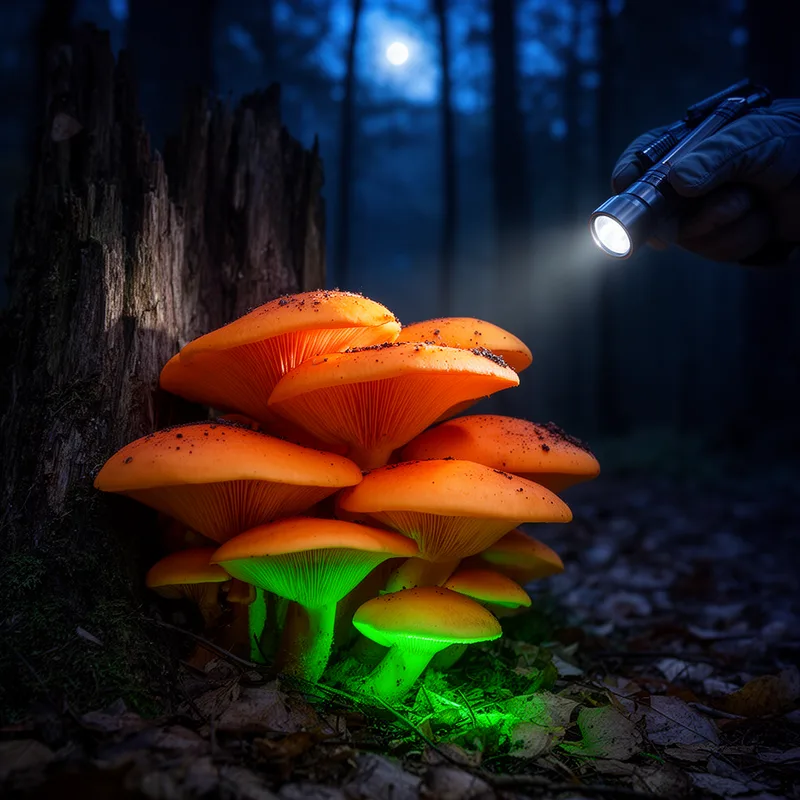
Omphalotus illudens
- noun
- /ɒmˈfælətəs ɪˈlʊdənz/
- Specialized
- Scientists warn that Omphalotus illudens is highly toxic and should never be consumed.
Examples
-
The Omphalotus illudens is often mistaken for edible chanterelles due to its bright orange color.
-
At night, the gills of the Omphalotus illudens can appear to glow in the dark woods.
-
The Omphalotus illudens can be found in damp, wooded areas.
-
Many foragers avoid the Omphalotus illudens due to its toxicity.
-
At night, the gills of the Omphalotus illudens can appear to glow, making it easy to identify this poisonous mushroom.
-
Scientists warn that Omphalotus illudens is highly toxic, making it unsafe for human consumption.
-
The Omphalotus illudens, commonly known as the Jack-o'-lantern mushroom, is often mistaken for edible mushrooms because of its bright orange color.
Synonyms

A large poisonous mushroom with an orange cap that glows at night

A large poisonous mushroom with orange caps that grows in tight groups and gills that glow in the dark
Surface Forms
Morphology
Omphalotus + illudens
This is a Latin binomial (scientific name) functioning as a proper noun label for a species; its meaning (a particular poisonous, luminescent mushroom) is not compositionally built from English morphemes. The second element 'illudens' has no lexical meaning for learners and even knowing the genus label does not let a B1 learner derive the species' properties, so the expression is unpredictable and non-compositional.
Etymology
Omphalotus illudens may come from two older words: Omphalotus meaning 'navel' because the cap often has a small dip, and illudens meaning 'to trick'. So the name paints a picture of a bright orange, glowing mushroom with a navel-like cap that 'tricks' people into thinking it is safe, which helps explain why this species is poisonous.

