
isostatic


 1
9.5
- adjective
- /ˌaɪsəˈstætɪk/
- Specialized
- Even the complexity of isostatic rebound and the indecidability of sea level tends to argue for asymmetric uncertainty and greater associated risk.
Examples
-
Ozark+JMG - There is much thought that the ongoing present-day seismicity in eastern North America is in part due to continuing isostatic rebound from the last ice age, 10,000 years after the fact.
Blog text (4) -
Wingham et al. report that "overall, the data, corrected for isostatic rebound, show the ice sheet growing at 5.1 mm year-1.
Blog text (34) -
Sea levels only rise if adjusted for isostatic rebound.
Blog text (10) -
The data from North Carolina reveal four phases of persistent sea-level change after correction for glacial isostatic adjustment.
Blog text (12) -
Calculate the rate of isostatic sinking of the Pacific Ocean floor resulting from post-LGM loading by water, the rate of compensatory land level rise, the rate of gravitationally induced sea level rise, and sea level changes from morphological changes to the ocean floor.
Blog text (30) -
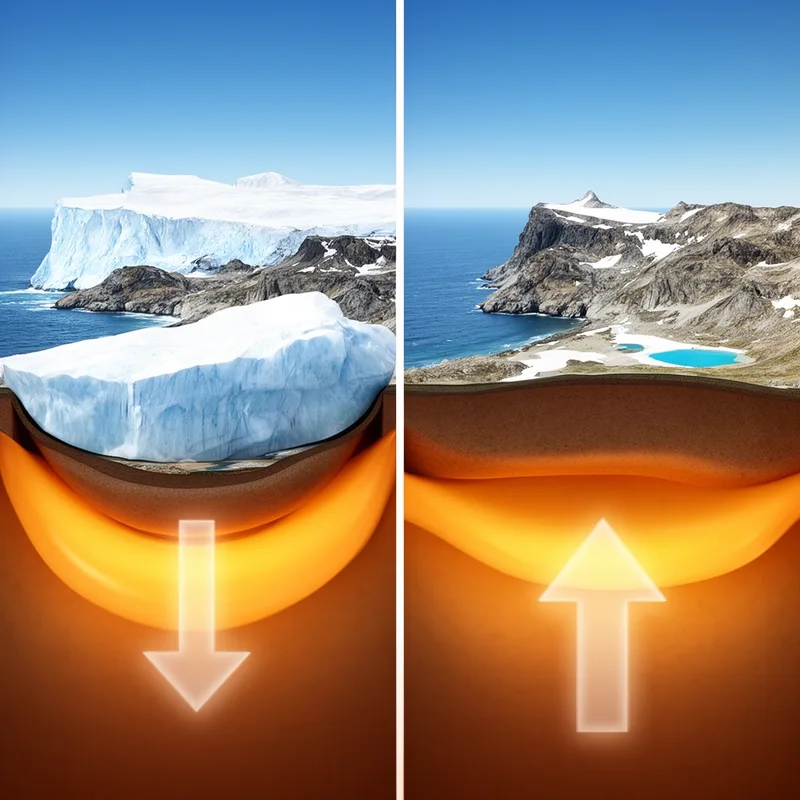
The concept of isostatic equilibrium is crucial for understanding how continents adjust to glacial melting.
-
Scientists study isostatic rebound to determine how Earth's crust adapts following significant weight loss.
-
Measuring isostatic adjustments helps geologists predict changes in sea levels resulting from ice sheet dynamics.
Surface Forms
Morphology
Etymology
The word isostatic comes from the parts iso- 'equal' and static 'standing', with static like the word 'not moving'. It describes how the land finds a new balance after weight changes, for example when large ice sheets melt and the ground slowly rises.